36 The Organ of Tomorrow
Overview: Frontal Systems and Control Beyond the Present
36.1 When the present does not specify the action
The action system developed in Chapter 30 is already predictive. The cerebellum estimates the consequences of commands before delayed sensory feedback can fully report them. The basal ganglia influence which actions gain access to downstream controllers, and dopamine-dependent learning changes those competitions according to their consequences. The ventral striatum does not merely react after reward arrives: human choices and striatal prediction-error signals can incorporate knowledge of the transitions that lead from one state to another, a hallmark of model-based control [@daw2011modelbased]. The hypothalamus introduced allostasis much earlier in the book — regulation that prepares for a need rather than waiting for the deficit to become severe.
The frontal lobes therefore do not introduce prediction into an otherwise reactive brain. Nor do they add value to a striatum that previously had none. Evolution did not save all foresight for the front of the human head.
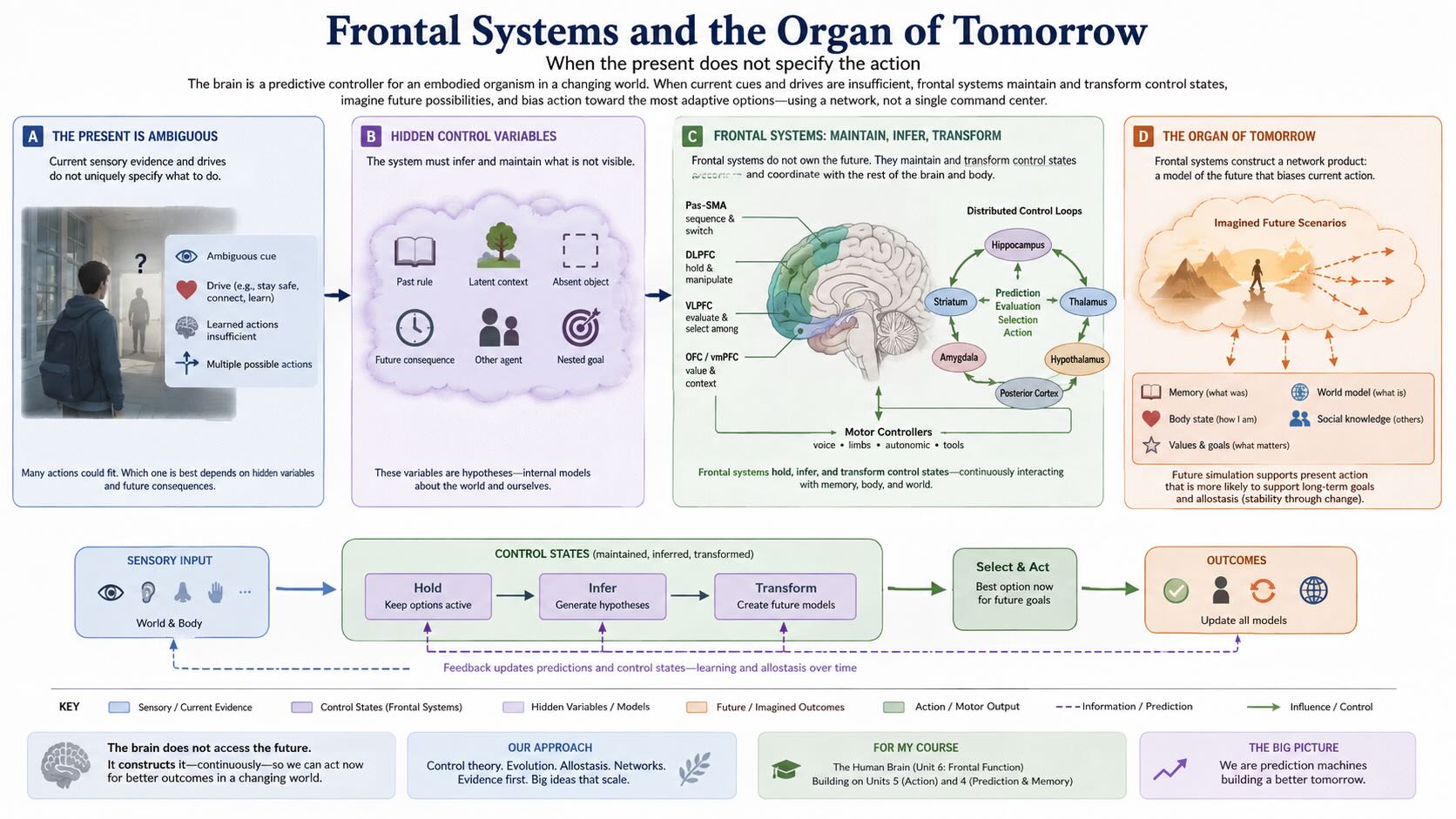
A different problem now comes into view. Sometimes the currently available sensory evidence, active drive, and strongest learned action are not enough to determine what the animal should do. A cue may be ambiguous because the relevant situation is hidden. A rule stated several seconds ago may reverse the response that the visible stimulus would ordinarily invite. One step in a plan may have to be completed while a larger goal remains protected. The animal may need to compare a familiar course with an uncertain alternative, imagine the consequence of an action that has never been taken, or allow a commitment to another person to outweigh the reward directly at hand.
In each case, behavior must be governed by information that is not fully specified by the immediate scene. The missing information may concern the future, but it may also concern the past, a latent context, an absent object, an abstract rule, another agent’s likely response, or a subordinate goal nested inside a larger plan. These variables must be maintained, inferred, revised, and used to alter activity throughout the rest of the controller.
That is the problem around which this unit is organized:
Frontal systems become especially important when the present does not specify what to do. They maintain, infer, and transform goals, rules, latent states, alternatives, and expected consequences, and use those control states to bias distributed cortical–subcortical loops.
The title The Organ of Tomorrow names the most consequential expression of this capacity. A body can be governed now by what it expects later. The title is not an anatomical claim that one lobe owns the future. Possible futures are assembled from memory, maps, bodily state, learned value, social knowledge, and models of how the world changes. Hippocampal damage can disrupt the construction of coherent imagined scenes, and ventromedial prefrontal damage can also impoverish remembered and imagined events [@hassabis2007imagine; @bertossi2016future]. The future is a network product. Frontal systems help make that product consequential for present control.
36.2 Control without an executive
The phrase executive function is useful in the clinic. It gathers together difficulties with planning, rule use, switching, inhibition, working memory, judgment, initiation, and the organization of behavior over time. A patient may speak fluently, recognize objects, remember facts, and score respectably on familiar tests while repeatedly failing to convert those intact abilities into an effective course of action. Calling the deficit executive alerts us that the problem lies not in one elementary sensory or motor operation but in how several operations are recruited and coordinated around a goal.
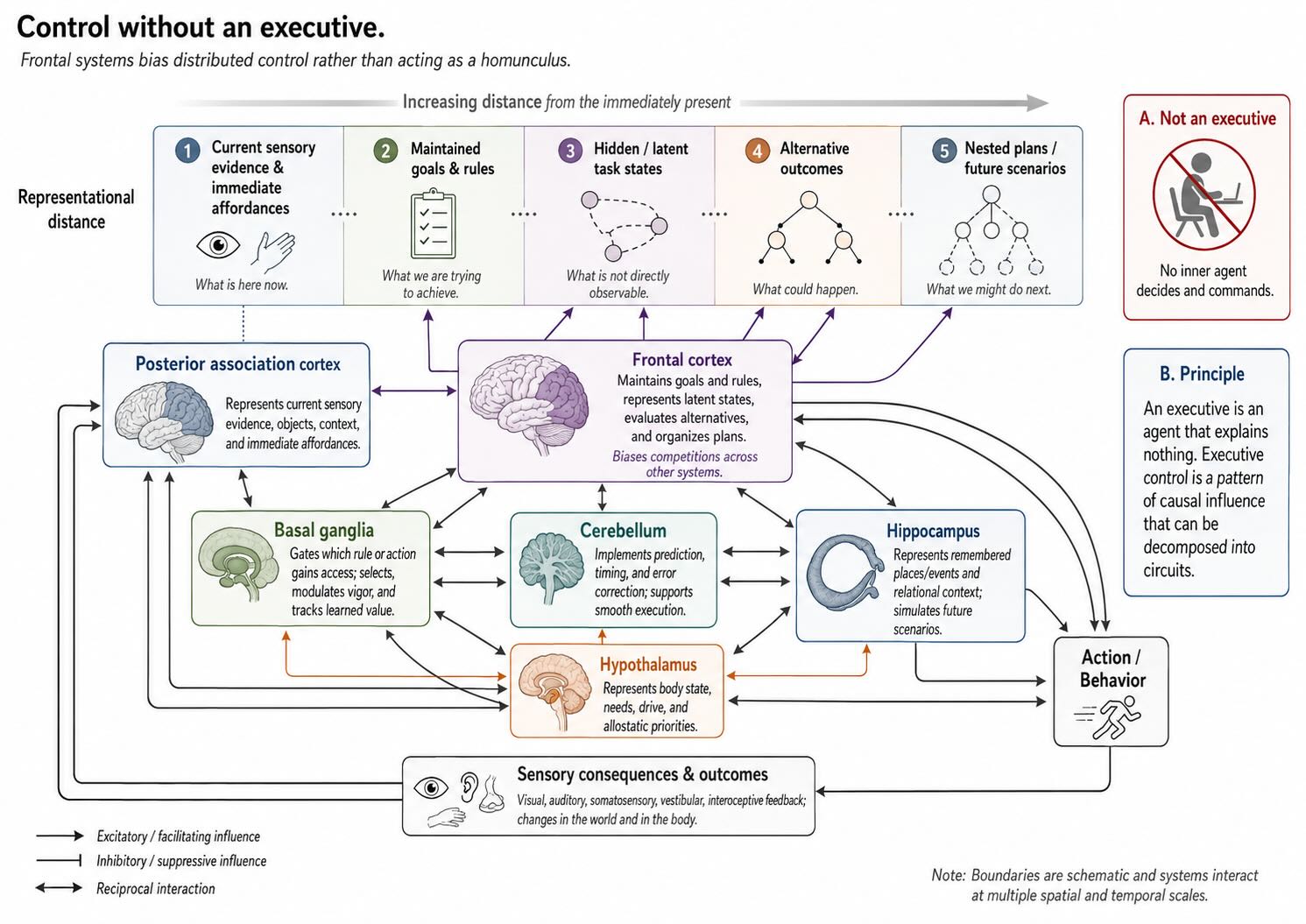
The trouble begins when the word is converted from a description into an explanation. An executive sounds like a person: someone who receives reports, weighs the options, decides what ought to happen, and sends instructions to subordinates. Placing such a figure in prefrontal cortex does not explain control. It hides the unexplained act of deciding inside a smaller decider.
This book has met the same temptation before. There is no agent inside the basal ganglia choosing a movement, no engineer inside the cerebellum calculating a correction, and no viewer inside visual cortex inspecting the cortical image. There is likewise no chief executive sitting behind the forehead. The homunculus has excellent job security because every unexplained function can be assigned to it. It remains unemployed in the tissue.
Frontal cortex contributes through mechanisms that can be studied: recurrent activity that preserves a task rule after the cue has disappeared; population states that distinguish one context from another; connections that amplify relevant sensory representations and suppress competing ones; corticostriatal loops that gate which rule or action is currently effective; thalamic loops that stabilize and update cortical states; signals that track alternatives, effort, uncertainty, and the need to change course. None is an executive by itself. Their coordinated effect is what executive control looks like from the outside.
The distinction matters because goals do not move muscles. A goal changes the conditions under which older controllers operate. It can increase the gain on one sensory source, keep one action policy available while another is being executed, suppress an otherwise dominant response, or change which outcome the striatum treats as valuable. Frontal systems govern behavior largely by biasing competitions elsewhere, not by writing a complete command and passing it down a chain.
This is still hierarchy, but not a hierarchy with one sovereign at the top. Spinal circuits control muscles and reflex gains. Brainstem systems control posture, orientation, and recurring action patterns. Basal ganglia alter access, vigor, and learned selection. Cerebellar circuits calibrate prediction and correction. Frontal systems add control states whose content may be abstract, counterfactual, socially transmitted, or temporally remote. Higher levels change the goals, gains, timing, and release conditions of lower ones while remaining dependent on their machinery and feedback.
A useful way to state the distinction is this:
An executive is an agent that explains nothing. Executive control is a pattern of causal influence that can be decomposed into circuits.
The rest of this overview begins that decomposition.
36.3 Ancient control problems, elaborated frontal systems
A mammal is not the first vertebrate to confront uncertainty, delay, or conflict between courses of action. A fish may have to continue toward shelter although a nearby movement attracts its attention. A bird may remember that one cue means retain this item and another means discard it. A foraging animal may leave a declining patch, investigate a novel object, or return to a place where a resource was found yesterday. The control problems are ancient because action has always extended through time.
The neural solutions are not identical across lineages. Mammalian prefrontal cortex is a particular elaboration of the pallium, embedded in loops with thalamus, basal ganglia, hippocampal formation, amygdala, hypothalamus, and brainstem. It should not be projected unchanged onto every vertebrate. Lampreys possess basal-ganglia and pallial systems that help organize action without possessing a primate-style granular prefrontal cortex. Birds solve sophisticated control problems with a pallium whose large-scale organization differs from the layered mammalian neocortex.
The avian nidopallium caudolaterale is especially instructive. It receives converging sensory and dopaminergic inputs, interacts with avian basal-ganglia and thalamic systems, and contributes to working-memory control, rule use, and value-guided behavior. In one experiment, pigeons were instructed on each trial either to remember a stimulus or to forget it. Neurons in this region maintained activity across the delay when the item was to be remembered and dropped that activity when the instruction was to forget; the birds’ later performance followed the same distinction [@rosecolombo2005]. A recognizable operation — controlling what remains behaviorally available — appears in tissue that is not a miniature primate frontal lobe.
That comparison supports analogy without requiring a one-to-one homology of every cortical area. Evolution can preserve ancient loops, alter pallial organization, and arrive at related control operations through different anatomical arrangements. Parrots and corvids also pack exceptionally large numbers of neurons into relatively small forebrains, which helps explain why brain mass alone badly underestimates their computational resources [@olkowicz2016birds].
The evolutionary sequence is therefore not reflex, then frontal cortex, then thought. Older vertebrate controllers already select, persist, switch, learn, and explore. Mammalian frontal systems enlarge the range of internal variables that can govern those operations. Primate granular prefrontal territories add further differentiation and long-range connectivity. Human brains extend the temporal, social, and symbolic scope of control still farther, but they do so by elaborating recurrent systems whose roots are much older.
Evolution again adds control above control without discarding what already worked.
36.4 A frontal sheet organized by gradients and loops
The frontal lobe includes more than prefrontal cortex. Its posterior edge contains primary motor cortex, and anterior to that lie premotor, supplementary-motor, frontal-eye-field, and cingulate-motor territories already introduced in Chapter 30. These regions transform goals and sensory evidence into organized movement. The present unit concentrates on the association territories farther anterior, ventral, and medial, while keeping their motor neighbors in the loop.
The boundary of prefrontal cortex is not supplied by one sulcus. Historically, prefrontal cortex was often defined as the cortical territory receiving dense input from the mediodorsal thalamus. That connection remains important, but it is not exclusive: mediodorsal projections vary across prefrontal areas, other thalamic nuclei contribute, and corticothalamic projections are broader than a simple reciprocal pair. Basal-ganglia relay nuclei can also send nonreciprocal thalamocortical projections that link one frontal circuit with another [@mcfarlandhaber2002]. The anatomy is a set of recurrent and partly overlapping loops, not a single cable from thalamus to an executive module.
The cortex itself varies systematically. Some orbital and medial regions are agranular or dysgranular, with a weakly developed layer IV. Other lateral and polar regions are more fully granular. Barbas and Pandya described basoventral and mediodorsal architectonic trends, each extending from less differentiated limbic cortex toward more differentiated isocortex [@barbaspandya1989]. These are gradients within an interconnected sheet. They are not two embryological organs, one destined to feel and the other destined to think.
Architecture nevertheless matters. Laminar differentiation predicts patterns of cortical connectivity; orbital and medial territories are strongly coupled to amygdala, hypothalamus, insula, hippocampal and parahippocampal systems, and visceral-control networks, whereas lateral territories are richly connected with parietal, temporal, sensory-association, premotor, and other frontal cortex. The amygdala itself projects across both basoventral and mediodorsal prefrontal sectors, with different patterns rather than one limbic stream ending in a single ventral box [@barbasdeolmos1990].
The practical lesson is to think in regional biases embedded in loops. Frontal territories differ, but none performs its characteristic operation alone. Value depends on sensory identity, current bodily state, memory, and learned consequences. Working memory depends on sensory and parietal representations as well as frontal control. Stopping depends on inferior frontal, medial frontal, basal-ganglia, thalamic, and motor systems. Initiation depends on cingulate, striatal, dopaminergic, thalamic, and brainstem networks. The following map is therefore a map of emphasis, not a set of sealed organs.
36.4.1 Orbital and ventromedial systems: states, outcomes, and value
The orbitofrontal cortex (OFC) lies above the orbits on the ventral surface of the frontal lobe. It receives highly processed information about taste, smell, vision, touch, and internal state, and it is strongly connected with amygdala, striatum, insula, and medial frontal cortex. Its contribution is often summarized as reward value, but that phrase is too small.
An outcome is not valuable in the abstract. It is a particular outcome expected in a particular situation. A piece of food matters differently when the animal is hungry or sated. A cue can predict reward in one context and punishment in another. A choice can be attractive because it leads to coffee rather than money, even when the two are assigned the same numerical value. OFC neurons can encode the values of offered and chosen goods in a common format [@padoaschioppaassad2006], but OFC also carries information about what outcome is expected and what state the organism is in.
The state problem becomes clearest when the decisive feature is hidden. Imagine a task in which the same visible stimulus requires one response after a reward and a different response after a loss. The screen may look identical on two trials, yet the correct action differs because recent history places the animal in a different latent state. Human OFC activity can represent such hidden task states and the relations among them — a cognitive map of a state space rather than a meter reporting pleasure [@schuck2016map]. This capacity helps explain why orbital damage can impair reversal, devaluation, and flexible credit assignment even when elementary perception and action remain intact.
The ventromedial prefrontal cortex (vmPFC) occupies the lower medial wall and overlaps, depending on the atlas, with medial orbital territories. Human imaging repeatedly finds vmPFC activity related to subjective value across very different goods. Food, consumer items, and monetary gambles can be expressed in overlapping vmPFC signals, providing evidence for a common scale on which unlike options can influence one choice [@chib2009common]. That does not mean the brain converts every possible future into one scalar and throws away its identity. Choice also requires information about what the outcome is, when it will occur, how uncertain it is, what effort it costs, and how it bears on the current body and self.
vmPFC also interacts with hippocampal and broader default-network systems during the construction of remembered and imagined situations. Lesions here can reduce the episodic detail and organization of both past and future events [@bertossi2016future]. The hippocampus contributes scene and relational structure; vmPFC helps relate constructed situations to schemas, value, confidence, and the concerns of the organism. Neither region owns mental time travel. Together with posterior medial, temporal, and parietal systems, they make an absent situation usable.
The OFC–vmPFC boundary should therefore be treated as a working anatomical distinction, not as a division between “object value” and “value for the self.” Different laboratories draw the labels differently, and vascular lesions rarely respect them. The firmer claim is that orbital and ventromedial systems participate in representing the current task state, the identity and worth of expected outcomes, and the way those outcomes matter for this organism now.
36.4.2 Lateral systems: rules, priorities, and maintained control
The lateral prefrontal cortex became famous through the delay period. In the classic oculomotor delayed-response task, a monkey sees a brief cue at one location, waits through a blank interval, and then directs its eyes to the remembered position. Neurons in dorsolateral prefrontal cortex can remain selectively active during the delay, preserving information that the current retinal input no longer contains [@funahashi1989mnemonic]. That finding gave neural substance to the idea of working memory.
It did not locate a single working-memory buffer. Precise mnemonic information can be decoded from visual, parietal, and frontal cortex, with the distribution depending on what is remembered and how it will be used. Frontal populations can contain stimulus-specific content, but they also represent rules, priorities, and task context [@ester2015workingmemory]. A useful distinction is that posterior systems often carry much of the content while frontal systems help determine which content remains relevant, what transformation should be applied to it, and when it should control action. The distinction is graded rather than absolute.
Rules make this role especially visible. A red light usually means stop, but in a laboratory it can be assigned to mean press left, compare two images, or ignore the next cue. Prefrontal neurons can encode abstract rules that generalize across the particular stimuli and movements used to express them [@wallis2001rules]. Such a rule is a control state: it changes how the same sensory event is mapped onto action.
Lateral frontal organization also shows a broad posterior-to-anterior gradient. More caudal regions lie close to premotor systems and are strongly engaged by concrete stimulus–response mappings. More rostral regions become increasingly important when behavior depends on contextual rules, nested contingencies, or the maintenance of a higher-order goal while a subordinate task is performed [@koechlin2003architecture; @badredesposito2007hierarchy]. This is not one axis called abstraction stamped uniformly onto the frontal lobe. Temporal depth, relational complexity, branching, and counterfactual reasoning overlap without becoming identical. The gradient is nevertheless a useful organizing tendency.
The ventrolateral prefrontal cortex, including parts of inferior frontal gyrus, contributes to controlled retrieval and selection among competing representations. Left ventrolateral territories are especially prominent when relevant semantic or episodic information must be recovered and irrelevant alternatives resolved. Right inferior frontal cortex is strongly implicated in stopping an initiated response. Focal damage can prolong stop-signal reaction time [@aron2003stopping], but stopping is not housed in one right-frontal brake. Inferior frontal cortex interacts with pre-supplementary motor cortex, subthalamic nucleus, striatum, thalamus, parietal cortex, and the motor system that must actually be interrupted [@aron2007network].
Lateral prefrontal cortex is therefore not the residence of a general faculty called inhibition. It maintains and transforms control states, selects among active representations, and helps recruit task-specific routes for continuing, changing, or stopping behavior.
36.4.3 Medial frontal systems: effort, change, and initiation
The medial wall cannot be reduced to the ventromedial valuation territories below. More dorsal regions include the dorsal anterior cingulate cortex, pre-supplementary motor area, and cingulate motor territories. These regions are recruited when an action is difficult, uncertain, costly, error-prone, or no longer worth continuing. They help evaluate whether control should be intensified, whether a strategy should change, and whether the expected outcome justifies the effort required.
Because medial frontal activity appears in so many demanding tasks, it has been called a conflict detector, an error monitor, an effort calculator, a foraging system, and a controller of control. No single label captures every result. The common problem is that the organism must evaluate progress and commitment: Am I succeeding? Is the current policy still worth its cost? Should I persist, switch, or stop investing?
A rare stimulation result makes the relation to commitment unusually vivid. Electrical stimulation near anterior midcingulate cortex produced a bodily sense that a challenge was approaching together with a determination to endure it — what the investigators called a “will to persevere” [@parvizi2013persevere]. That does not reveal a will center. It shows that a medial frontal node can causally alter a distributed state combining anticipated cost, autonomic preparation, and persistence.
At the severe end, bilateral damage to cingulate and adjacent medial frontal systems can produce profound loss of spontaneous action and speech. Those syndromes will close the unit. They are not failures of muscle strength or comprehension. They reveal that making an action available is different from mobilizing the organism to initiate and sustain it.
36.4.4 Frontopolar systems: alternatives, branching, and exploration
The frontopolar cortex, at the anterior tip of the frontal lobe, becomes prominent when one course of action must be pursued without losing track of another. A person can suspend one task, complete a subgoal, and return; compare the current plan with a counterfactual alternative; or keep evidence for a rejected option available in case conditions change. This is sometimes called branching.
Human frontopolar activity tracks evidence favoring an alternative course while the current choice is being followed [@boorman2009alternatives]. That operation is valuable whenever commitment must remain revisable. A controller that never commits cannot act. A controller that erases every unchosen alternative cannot adapt.
The same territory contributes to directed exploration — choosing an uncertain option because learning about it may improve later decisions. Disrupting right frontopolar cortex with transcranial magnetic stimulation selectively reduces this information-seeking component while sparing exploration produced by increased choice variability [@zajkowski2017frontopolar]. The result will matter later in this overview. Exploration is not merely a lapse of control. Under the right conditions, control deliberately buys information.
36.5 What damage removes
Frontal lesions have carried an unusual share of the explanatory burden in this field. They are compelling because the affected person can retain language, recognition, movement, and much learned knowledge while becoming unreliable in the organization of life. The temptation is to say that the lesion has removed the executive. The clinical patterns argue for a more specific conclusion.
A lesion is not a clean subtraction of one cortical box. Stroke follows vascular territories. Trauma damages white matter and distant tissue. Tumors displace and infiltrate. A focal injury can alter activity in connected regions through diaschisis, and recovery changes the network again. Lesion evidence is strongest when the anatomy, behavioral analysis, time course, and converging physiology agree. This qualification belongs here once; it need not be repeated after every patient.
36.5.1 When expected outcomes no longer govern choice
Patients with orbital or ventromedial damage can describe ordinary social rules and perform normally on many conventional tests while making choices that repeatedly damage their finances, relationships, health, or safety. In laboratory gambling tasks, some fail to develop the anticipatory autonomic responses that normally appear before a risky choice [@bechara1996autonomic]. The result supports a real contribution of bodily and affective prediction to decision-making.
It does not settle the entire somatic-marker hypothesis. The original claim proposed that nonconscious bodily signals guide advantageous choice before participants can state what they know. More sensitive questioning showed that healthy participants often possess more explicit knowledge of the task than early reports detected [@maiamcclelland2004]. The secure finding is not that the body decides in place of cognition. It is that valuation and choice are embodied: autonomic, interoceptive, affective, mnemonic, and conceptual information interact, and ventromedial damage can disrupt the integration.
The same principle applies to moral judgment. vmPFC lesions can alter responses to a restricted class of high-conflict dilemmas in which personally harming one person would improve aggregate outcomes [@koenigsetal2007moral]. That result does not place morality in vmPFC, turn moral reasoning into emotion versus arithmetic, or make acquired frontal injury equivalent to developmental psychopathy. Moral behavior depends on learned norms, representations of intentions and consequences, emotional responses, social knowledge, and the capacity to model other agents. The later chapter will treat the lesion result as one causal constraint within that larger system.
36.5.2 When a known rule loses control
A person can remember an instruction and still fail to implement it. Goal neglect names this dissociation: the requirement is understood and can be repeated, yet it drops out of the control of behavior when several demands compete. Novelty, weak external feedback, and multiple task requirements make the failure more likely [@duncanetal1996goal]. The missing operation is not knowledge of the rule but its effective organization within a task model.
Other patients perseverate, continuing to sort, search, speak, or act according to a rule that is no longer appropriate. The familiar Wisconsin Card Sorting Test can reveal this failure, although poor performance is not specific to frontal damage and good performance does not guarantee intact everyday control. That is an important clinical lesson: a task can probe a control problem without serving as a scanner that points to one lobe.
Distractibility, goal neglect, and perseveration may look opposite — changing too easily versus failing to change — but both concern the regulation of control states. An effective controller must stabilize a rule against irrelevant competition and destabilize it when evidence says the rule is wrong. Persistence and flexibility are not rival virtues. They are opposing demands that the same organism must arbitrate.
36.5.3 When the environment takes command
François Lhermitte described patients who grasped and used objects placed before them although no one had asked them to do so. A comb was used to comb, spectacles were put on, and a glass invited drinking. The ordinary affordance had become abnormally compelling. He called this utilization behavior [@lhermitte1983utilization]. Related patients imitated the examiner’s gestures or treated the accidental social situation as an instruction.
The behavior is sometimes summarized as release from frontal inhibition, but the deeper point is the loss of autonomy from the immediate environment. Objects always offer actions. In intact control, those affordances compete with goals, rules, social context, and longer-range consequences. After particular frontal-network injuries, the visible invitation can win by default.
A case following paramedian thalamic infarction produced similar utilization behavior [@eslingeretal1991thalamic]. That is exactly what a loop account predicts. A syndrome can look “frontal” when a connected thalamic node is damaged because the relevant unit is the network that maintains and applies control states, not the cortical patch alone.
36.5.4 When tomorrow never comes
At the other extreme, the problem is not capture by an object but failure to set out at all. Apathy refers to reduced goal-directed behavior, cognition, and emotion. Abulia is a more severe reduction in initiative and spontaneous action. Akinetic mutism can leave a person awake, visually tracking, and physically capable of movement while producing almost no spontaneous speech or action.
Bilateral lesions involving anterior cingulate and supplementary-motor territories are one cause [@nemethetal1988akinetic]. Similar syndromes can follow damage elsewhere, including thalamic, basal-ganglia, midbrain, and white-matter sites. Lesion-network analysis shows that spatially different lesions associated with abulia or akinetic mutism can converge through functional connectivity on a common network [@darbyetal2018volition].
These patients do not reveal a single reservoir of will. They reveal a distributed initiation system linking expected value, effort, autonomic preparation, action selection, and motor release. An available goal is not yet an initiated action. A plan can be verbally stated while failing to recruit the energy and control needed to begin.
This is where the title of the final chapter comes from. Some patients can speak about tomorrow. Their behavior does not lean toward it. Tomorrow never comes.
Across these syndromes, the chief is never found dead in its office. What disappears is more informative: outcome updating, rule maintenance, flexible switching, independence from the immediate environment, or the initiation of sustained action. Frontal damage removes tools of control, and different tools can fail separately.
36.6 Human elaboration without a new organ
Few claims about human evolution are repeated more confidently than the claim that our frontal lobes became disproportionately large. The answer depends heavily on what is measured, where the boundary is drawn, which species are compared, and whether size is expressed as a proportion of the whole cortex or relative to an allometric prediction.
Some analyses find that human frontal-lobe volume scales as expected for a primate brain of our size [@bartonvenditti2013]. Cell counts likewise suggest that prefrontal cortex contains roughly the expected share of cortical neurons, with the human distinction lying in the enormous absolute number available rather than an exceptional percentage [@gabietal2016neurons]. Other work, using boundaries based more closely on cytoarchitecture and function, finds preferential expansion of prefrontal gray matter and especially its underlying white matter relative to macaques and chimpanzees [@donahueetal2018quantitative]. Earlier MRI comparisons also emphasized disproportionate human prefrontal white matter [@schoenemannetal2005white].
These results do not require a winner-take-all verdict. They address different measurements, and their disagreement itself blocks the cartoon in which evolution simply inflated the front third of the human brain. The more defensible synthesis is anatomical and connectional.
Human frontal systems operate with very large absolute numbers of neurons, extensive long-range white matter, prolonged development, and expanded association networks linking frontal, parietal, temporal, hippocampal, striatal, thalamic, and cerebellar systems. Their specializations include granular lateral and frontopolar territories capable of maintaining deeply nested, symbolically defined, and socially transmitted control states. Language and culture allow a rule learned from another person to govern behavior years later and far from the situation in which it was acquired.
Human exceptionalism therefore survives, but not as a percentage in a pie chart. The remarkable feature is the scale and reach of the network: how many variables can be related, how far their consequences can be projected, how many subordinate goals can be nested, and how powerfully a socially represented future can override the affordance directly in front of the body.
The human frontal lobe is not a new organ. It is an ancient control architecture elaborated until tomorrow, another person’s tomorrow, and an institution’s imagined century can all compete with now.
36.7 Exploration as an allostatic investment
A controller cannot choose among possibilities it has never discovered. It cannot return to water whose location was never learned, take an alternate route it never sampled, seek help from a partner it never encountered, or recognize that a familiar resource has a better replacement. Knowledge of the world changes the actions that will be available when the body later needs them.
This book proposes a strong organizing idea:
Exploration is an allostatic investment in future controllability.
The immediate costs are real. Exploration consumes time and energy. It can expose the animal to predators, injury, competition, and misleading information. The return arrives later. A mapped water source shortens the search when thirst develops. Knowledge of several shelters prevents one blocked route from becoming a crisis. Familiarity with social partners enlarges the set of agents from whom information, protection, mating opportunities, or cooperation may be obtained. Sampling alternatives makes the organism less dependent on one brittle policy.
In control terms, exploration can increase the number, accessibility, and reliability of actions through which a later disturbance can be corrected. It can reduce future search cost, shorten delay, reveal hazards before urgency narrows the options, and provide redundancy when a familiar solution fails. That is what future controllability means here. It is not a feeling of mastery. It is a larger and better-estimated set of ways to regulate the body in a changing world.
36.7.1 Exploration is not one behavior
Several processes are often placed under the same label. Directed exploration favors an uncertain option because information from that option may improve later choices. Random exploration increases variability, allowing a less favored option to be sampled without explicitly assigning it an information bonus. Humans use both strategies, and both increase when the decision-maker expects more future choices in which the information could pay off [@wilsonetal2014exploration]. Novelty seeking, investigatory behavior, patch leaving, play, and search after a familiar policy fails overlap with these strategies but are not identical to them.
This distinction prevents curiosity from becoming another invisible faculty. A mouse approaching a novel object, a monkey preferring advance information, and a person choosing an uncertain arm of a bandit task may all acquire information, but the sensory variables, costs, neural routes, and future uses differ. Exploration is an adaptive class of control policies, not one drive with one anatomical address.
Exploration also changes the controller itself. In monkeys shifting from exploitation to exploration, choice-predictive activity in a prefrontal sensorimotor area becomes less stable while learning from new outcomes increases [@ebitzetal2018exploration]. The system temporarily loosens a reliable mapping so that alternatives can be sampled and a new mapping discovered. What looks locally like noisier control can be globally useful.
36.7.2 Wandering when full
Satiation provides a revealing ecological case. When hunger, thirst, or immediate danger is severe, the opportunity cost of unrelated exploration is high. A known route to the needed resource usually deserves priority. When urgent drives are quiet and energy reserves are adequate, the organism can afford to sample the environment without demanding an immediate payoff. Wandering when full can therefore gather information under conditions in which failure is survivable.
But exploration does not occur only in satiety. Hunger can drive a search beyond a depleted patch. Uncertainty can provoke checking. Environmental change can make the familiar policy unreliable. Threat can force discovery of another escape route. The important claim is not that homeostatic silence flips on a unitary curiosity drive. It is that bodily state changes the price of information and the horizon over which its benefits can be collected.
This is where exploration becomes allostatic rather than merely exploratory. Allostasis prepares for likely future demands by acting before the regulated variable reaches crisis. Exploration prepares by acquiring the world-knowledge from which later regulation can be organized. An animal that waits until it is desperately thirsty to begin learning the terrain has left itself very little control margin.
36.7.3 The machinery is distributed
Frontal cortex contributes importantly to the arbitration. Frontopolar systems track alternatives and support directed information seeking; lateral systems regulate decision variability and maintain the horizon over which information will matter; medial frontal systems evaluate the cost of continuing a current policy versus leaving it. Human foraging tasks implicate dorsal anterior cingulate and related systems, although whether activity tracks foraging value, choice difficulty, or the control demand created by the two cannot be read from one contrast alone [@kollingetal2012foraging]. The general point is that exploitation and exploration require different control states.
The map being improved depends strongly on hippocampal and cortical memory systems. Dopamine and noradrenaline alter learning, novelty responses, gain, and behavioral variability. Basal ganglia determine which investigatory actions gain access to the body. Tectal and brainstem systems orient toward novelty. The zona incerta supplies a striking subcortical example. In mice, a prelimbic-cortex–medial-zona-incerta–periaqueductal-gray circuit helps initiate sustained investigation of novel objects and conspecifics [@ahmadlouetal2021investigatory]. In monkeys, a temporal-cortex projection to zona incerta contributes to novelty seeking [@ogasawaraetal2022novelty]. Curiosity did not wait for the human frontal pole.
The allostatic proposal concerns the function of this distributed behavior at the level of the organism. It does not claim that every exploratory act is consciously aimed at future regulation, or that every novelty response is beneficial. Animals can waste effort, enter traps, and pursue novelty that has been engineered to capture them. The proposal is that selection favored systems willing to pay some present cost for information because, across uncertain environments, that information enlarged later control.
The idea now connects three units of the book. Chapter 6 established a body whose needs vary and can be anticipated. This unit asks how the controller decides when to leave a known policy and purchase information. The next unit will ask how exploration alters the maps and memories from which routes, scenes, and possible futures are later constructed.
36.8 The six problems ahead
The unit is organized around six control problems rather than a march from one gyrus to the next. The same frontal territories and subcortical loops will recur because the problems interact.
A Common Currency asks how unlike possibilities can enter one choice. Neural signals in vmPFC, OFC, striatum, and related systems often covary with subjective value, but the chapter will not treat a scalar as the whole decision. A controller must compare options while preserving outcome identity, delay, uncertainty, effort, and bodily relevance. The problem is not simply where value is located. It is how several kinds of information become commensurable enough to guide one action.
Holding the Line asks how a selected goal remains effective after the cue has disappeared and while the world offers easier alternatives. Working memory, rule representation, attention, response selection, and stopping enter as aspects of maintained control. The clinical contrasts include goal neglect, distractibility, perseveration, and environmental capture. The chapter’s central problem is how the controller remains stable without becoming rigid.
Feeling the Future returns to the body. Anticipated outcomes change autonomic and interoceptive state before the outcomes occur, and those signals can alter choice. The somatic-marker hypothesis provides one influential account, but it is a hypothesis about how bodily prediction guides uncertain decisions, not a name for a settled frontal machine. The chapter will separate the strong evidence for embodied valuation from the more specific claim that nonconscious somatic markers decide before explicit knowledge is available.
The Futures of Others extends control into a social world. Other agents have goals, knowledge, intentions, and reactions of their own. A promise, threat, norm, or moral rule allows another person’s possible future to alter present behavior. This is not vmPFC performing morality. It is a distributed problem involving valuation, memory, language, affect, perspective taking, causal inference, and the control of one’s own action in relation to autonomous others.
Wandering When Full develops exploration as an allostatic investment. It will distinguish open-ended exploration from need-directed search, examine directed and random strategies, and ask how bodily state changes whether information is affordable. The animal that explores is not taking a vacation from regulation. It is altering what regulation will later be able to do.
Tomorrow Never Comes closes with apathy, abulia, and akinetic mutism. These syndromes reveal the gap between representing a possible action, valuing it, and mobilizing the organism to begin and persist. Medial frontal cortex, basal ganglia, thalamus, dopamine systems, and brainstem arousal all enter. The chapter asks what turns a goal from available information into an initiated course of action.
These are not six serial stages through which a decision passes. There is no pipeline in which OFC computes value, dorsolateral cortex holds it, cingulate supplies effort, and motor cortex obediently executes. The chapters are six views of recurrent frontal–subcortical systems controlling an embodied animal across time.
36.9 Coda: governed by what is not yet here
The frontal lobes are easy to mythologize because their damage can alter the organization of a life. A visual lesion may remove part of the field. A motor lesion may weaken a limb. A frontal lesion can leave the parts available while changing which future the person repeatedly builds, values, protects, or begins. The deficit feels closer to character because character is expressed in extended patterns of choice.
The anatomy offers no warrant for a chief. Orbital and ventromedial systems represent states, outcomes, and value in interaction with amygdala, hippocampus, insula, striatum, and hypothalamus. Lateral systems maintain and transform rules and priorities through frontoparietal, thalamic, striatal, and sensory loops. Medial systems relate progress, cost, persistence, and initiation to action. Frontopolar systems keep alternatives alive and make information itself worth purchasing. Each contribution is partial. Their recurrent combination lets an absent variable reorganize present behavior.
The controller can then refuse the brightest affordance because a remembered rule says no. It can endure present cost because a remote outcome is valued. It can stop exploiting a reliable option because uncertainty elsewhere may be worth resolving. It can act for a person who is not present, preserve a commitment across years, or fail so profoundly to initiate that tomorrow remains only something said.
Frontal systems do not manufacture the possible worlds that govern these acts. The hippocampus and connected cortical networks supply relational and scene structure; memory contributes the fragments from which novel situations are built; sensory systems contribute the properties of objects and places; the hypothalamus and body determine what is at stake; basal ganglia and dopamine systems learn and select; cerebellar systems predict the consequences of action. The frontal contribution is to keep, infer, compare, and apply control states whose referents may be absent, hidden, nested, or not yet real.
That is enough to earn the title. The frontal lobe is an organ of tomorrow because it helps the organism become governed by what is not yet here.
The next unit turns to the machinery that makes such government possible. Before a future can control action, it must be constructed. The road forward therefore runs backward — into navigation, memory, and the predictive maps from which an animal learns where it has been and where it might go next.
Established findings. Prefrontal cortex is architecturally heterogeneous and embedded in recurrent loops with thalamus, basal ganglia, posterior cortex, hippocampal formation, amygdala, hypothalamus, insula, cerebellum, and brainstem. Orbital and ventromedial damage can impair flexible outcome-guided choice; lateral damage can impair rule-guided control; medial frontal and connected subcortical damage can impair initiation. Working-memory content is distributed, stopping recruits a network, and exploration includes behaviorally and neurally distinguishable strategies.
The organizing interpretation of this unit. Frontal systems become especially important when immediate sensory evidence and established policy do not specify what to do. Their contribution is not a general intelligence fluid or an executive agent. They maintain, infer, and transform control states that change which distributed representations and actions govern the body.
The proposal developed in this book. Exploration is an allostatic investment in future controllability. By spending energy, time, and risk to acquire information before a need becomes urgent, an organism can enlarge the set of reliable actions available when conditions later change. The proposal links regulated bodily state, frontal arbitration, and the predictive maps of the next unit. It is meant to organize testable relationships, not to rename every instance of novelty seeking as allostasis.