15 Exploration
The Regulated Body
15.1 The adaptive problem: discovering future affordances
Most of the regulatory systems in this unit defend a variable that can be named directly. Thermoregulation defends core temperature. Fluid balance defends osmolarity, sodium, and blood volume. Energy balance defends usable fuel and stored reserve. Exploration is harder to place in that list because the defended variable is not a molecule, pressure, or temperature. The animal is defending something more abstract: future controllability. It is gathering information that will make later regulation faster, cheaper, and less dangerous.
That makes this chapter different from the others, and it should be read with the proper caution. There is no single “exploration hormone” and no classical hypothalamic nucleus that deserves to be called the curiosity center. The strongest causal evidence for directed novelty investigation points to the zona incerta (ZI), a diencephalic structure usually classified as subthalamic or prethalamic rather than as a hypothalamic nucleus. The hypothalamus proper still matters, especially through circuits that regulate arousal, energy state, stress, sleep-wake stability, and novelty-to-hippocampus routing. But the honest framing is this: exploration is organized by a diencephalic and brainstem state-control network, not by one hypothalamic switch.
The problem is not trivial. An animal that first searches for water when dehydration is already severe has waited too long. An animal that first learns the escape routes when a predator appears is already behind. An animal that first discovers shelter after a cold front arrives, or first samples possible foods when starvation has begun, is forced to solve a future problem as a present emergency. Exploration prevents some of those emergencies by building usable knowledge in advance: where food has been found, where water collects, which paths are safe, which openings lead to cover, which individuals are dangerous, which are potential mates or allies, and which cues predict change.
The key word is affordance. A rock face may afford shelter. A tree may afford fruit, shade, a lookout point, or a route of escape. A dark opening may afford cover or danger. A novel odor may afford food, poison, social information, or threat. Exploration is how the animal learns these possibilities before they are needed. The product of exploration is therefore not a detached cognitive map of space. It is a body-centered map of what the world might let the animal do.
This also means that we need to separate three related states. Open-ended exploration occurs when the animal samples novelty without an immediate consummatory target. Need-directed search occurs when hunger, thirst, cold, sexual motivation, or another regulatory demand narrows behavior toward a particular kind of affordance. Defensive scanning occurs when novelty is sampled under threat, but the main question is whether danger is present and how to avoid it. These states can blend together.
It is useful but incomplete to think of exploration as something that occurs in a homeostatic “green zone.” Physiological sufficiency and safety can permit broad, open-ended exploration, but homeostatic deficit can also drive exploration. The better claim is that bodily state changes the question the animal is asking of the world. When the body is stable and safe, the question can be broad: what is here, what has changed, what might matter later? When a deficit is urgent, the question narrows toward the affordances relevant to that need.
From the perspective of allostasis, exploration is one step earlier than the systems we have already considered. Predictive thirst uses oral, gastric, and osmotic cues to regulate water before the blood has fully changed. Predictive hunger uses sight, smell, taste, gut signals, and adiposity signals to regulate intake before cellular fuel has become dangerous. Exploration gathers the information that makes those later predictions possible. It is not merely a response to a forecast. It improves the forecasting system itself.
It is tempting to say that exploration is simply what animals do when other drives are quiet. That is partly right, but it is not enough. Exploration is costly. It uses energy, increases exposure to predators and pathogens, and can lead an animal away from familiar resources. A behavior with those costs would not persist if it were only empty activity filling unused time.
A cautious way to state the evidence is to separate three claims. The first is well-supported: many animals, including humans, seek novelty and information, and information can have motivational value even when it does not immediately deliver food, water, sex, or safety. The second is also well-supported: hypothalamic and hypothalamic-adjacent circuits participate in the arousal, locomotion, state-gating, novelty processing, and hippocampal map-updating that make exploration possible. Causal work on the medial zona incerta further shows that novelty investigation can be actively promoted rather than merely appearing as a by-product of locomotion. The third claim is more interpretive: exploration can be understood as an allostatic drive for discovering future affordances. That is the synthesis developed in this chapter.
So the safest answer is yes, but with qualifications. Exploration is not a drive in the same clean way that thirst is a drive. It does not defend one measurable internal variable, and it is not triggered by one bodily sensor. But it is also not just the absence of hunger, thirst, fear, or sleep pressure. It is an active state in which the animal spends present resources to improve future regulation.
15.2 Sensors and signals: sufficiency, deficit, safety, novelty, and uncertainty
Exploration depends on several streams of information that answer different questions. Some signals ask whether the body can afford broad exploration. Others ask whether a deficit should narrow exploration toward a particular goal. Others ask whether the world is safe enough. Still others identify novelty, uncertainty, and mismatch — the features that make exploration worth doing in the first place. Unlike thirst or hunger, these signals do not converge on a single blood value. They converge on a behavioral decision: should the animal keep exploiting what it already knows, or spend resources learning something new?
The first class of signals is permissive. Adequate energy reserve lowers the urgency of food seeking. Fluid balance lowers the urgency of drinking. Thermal comfort lowers the urgency of finding shade, warmth, water, or shelter. Stable wakefulness makes sustained sampling possible. Low pain, low sickness, and low immediate threat reduce the cost of leaving a familiar position. These signals arrive through the same routes described throughout the unit. Leptin, insulin, ghrelin, and nutrient signals act on the arcuate nucleus, median eminence interface, brainstem, and vagal pathways. Osmotic and volume signals reach lamina terminalis structures such as the SFO and OVLT, and then hypothalamic targets involved in thirst and vasopressin release. Visceral information travels through vagal afferents to the NTS and area postrema. Thermal and pain information ascends through spinal and parabrachial relays to the preoptic area and defensive systems. Sleep pressure and circadian phase reach hypothalamic arousal circuits through the SCN, preoptic sleep systems, and lateral hypothalamic orexin neurons.
These permissive signals do not command exploration by themselves. A sated, hydrated, warm animal may sleep. It may groom. It may stay near its young. It may remain hidden because the environment is dangerous. The point is that urgent physiological error changes the cost-benefit calculation. When the body is far outside its defended range, broad sampling of the world becomes expensive and sometimes dangerous. The controller shifts from learning what the world might afford later to correcting the problem that matters now.
A second class of signals carries deficit pressure. Hunger, thirst, cold, reproductive state, and caregiving demands can all increase movement into the environment, but they tend to make that movement more selective. Deficit-driven search is therefore exploratory in the everyday sense, but it is not identical to open-ended curiosity. It is exploration under an imposed question.
A third class of signals supplies the brakes. Predator odor, sudden movement, looming visual stimuli, social threat, injury, inflammation, nausea, high heat, severe cold, dehydration, starvation, and sleep pressure can all narrow exploration. Threat signals engage the amygdala, BNST, hypothalamic defense circuits, periaqueductal gray, parabrachial nucleus, and autonomic systems. These signals do not merely make the animal feel afraid. They change the motor policy: freeze, flee, hide, avoid open spaces, stay near walls, reduce contact with novel objects, or inspect from a distance. In rodent work, the contrast between thigmotactic locomotion — wall-hugging movement in an open arena — and focused investigation is especially useful. Both involve movement. They are not the same state.
A fourth class of signals supplies the positive pull of exploration. Novel objects, unfamiliar places, ambiguous sounds, new odors, changed routes, unexpected social individuals, and prediction errors all mark parts of the world where the current map is incomplete. Sensory cortices register stimulus novelty. Higher visual and temporal cortical regions represent object identity and familiarity. The superior colliculus helps orient the eyes, head, and body toward salient events. The hippocampal formation detects contextual mismatch and updates spatial and episodic maps. The amygdala and BNST evaluate whether novelty is promising, threatening, or ambiguous. Dopamine, norepinephrine, acetylcholine, and orexin adjust the gain of arousal, attention, learning, and approach.
The crucial point is that novelty is not only sensory. It is relational. A stimulus is novel relative to memory, expectation, and state. A new object in a safe home cage may invite investigation. The same object in an exposed field may be treated as danger. A new food odor may be attractive during hunger and irrelevant after feeding. A new social individual may be an opportunity, a rival, a predator, or a disease risk depending on species, sex, reproductive state, past experience, and context. The brain does not simply detect novelty. It asks what novelty means for this body now.
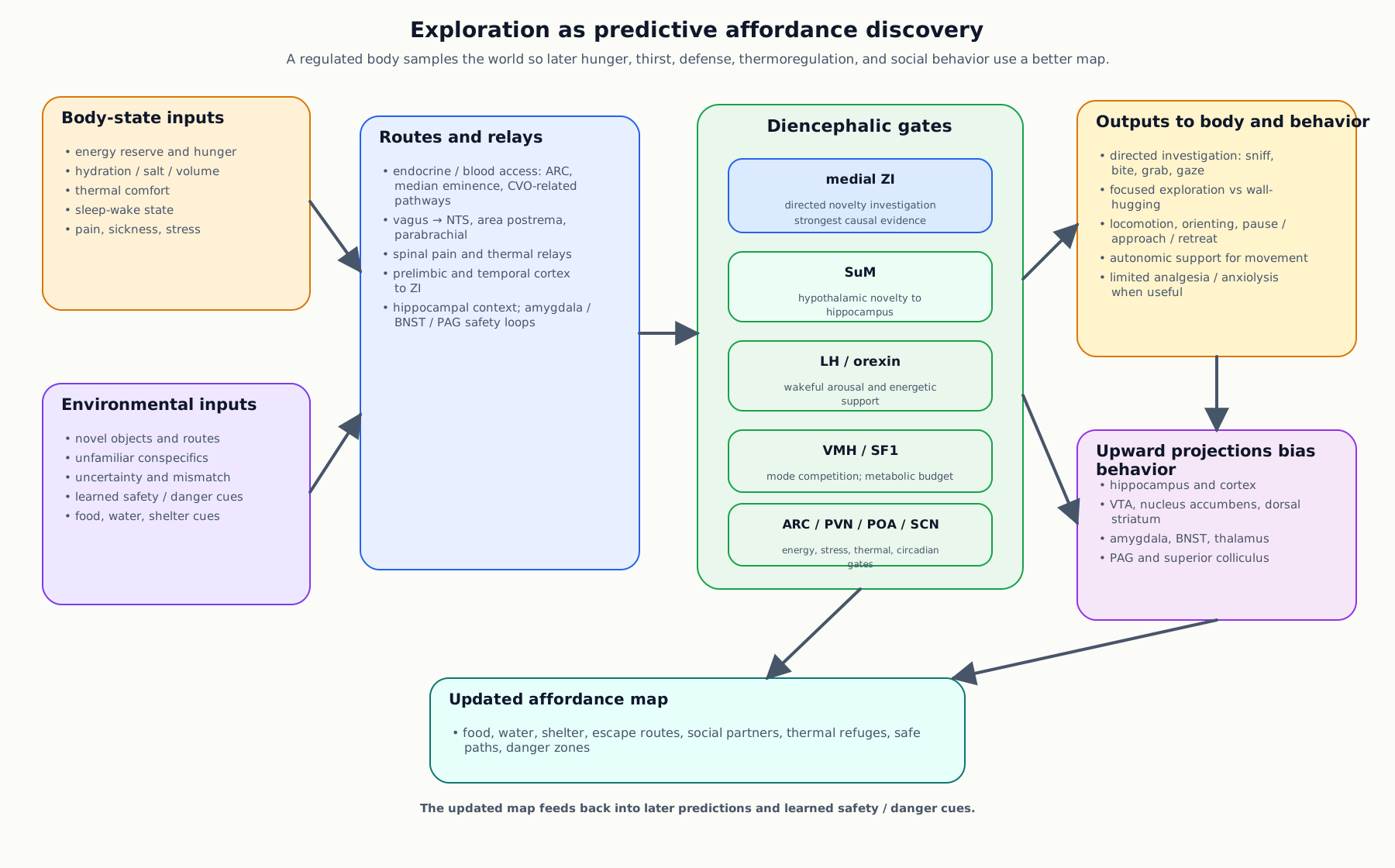
15.3 Hypothalamic circuits: state gates, novelty gates, and action release
The old language of hypothalamic “centers” is especially misleading here. The circuit is better understood as a set of gates and competitors. Some nodes report whether the body can afford broad sampling. Some energize wakeful movement. Some transform novelty into orienting and approach. Some route novelty into hippocampal memory. Some impose brakes when hunger, thirst, pain, fatigue, thermal stress, or threat should dominate.
A useful first node is the lateral hypothalamus (LH). The LH was once described as a feeding center because lesions produced aphagia and adipsia, but that label is too narrow. As we saw in Chapter 9, the LH participates in arousal, appetitive motivation, reward, locomotion, and the willingness to work for biologically important outcomes. Its orexin/hypocretin neurons are especially relevant because they project widely to the locus coeruleus, raphe nuclei, tuberomammillary nucleus, VTA, nucleus accumbens, amygdala, cortex, and brainstem autonomic and motor systems. Through those projections they help stabilize wakefulness and energize motivated action.
That does not mean orexin is a curiosity molecule. Orexin activity rises in many states that require aroused action: food seeking, stress, reward pursuit, waking, and locomotion. Some orexin manipulations produce hyperlocomotion, grooming, or stereotyped action rather than directed investigation. Recent work on orexin receptor type 1 in dopaminergic neurons also complicates a simple “more orexin means more exploration” story: loss of that receptor in dopamine neurons increased novelty-induced locomotion and exploration in mice. The safest conclusion is that orexin helps set the arousal and action platform on which exploration can occur, while its effects on novelty-directed behavior depend on cell type, projection target, and behavioral context.
A second node is the supramammillary nucleus (SuM), a posterior hypothalamic region just above the mammillary bodies. The SuM gives this chapter its clearest classical-hypothalamic bridge to exploration. It projects strongly to hippocampal regions, including the dentate gyrus and CA2, and it participates in hippocampal theta, locomotor coupling, novelty processing, and memory modulation. That makes it almost tailor-made for the present argument. Exploration is movement through a changing world, but the movement matters because it updates a map. The SuM helps link those two facts.
The most important SuM finding for this chapter is that different SuM projection populations appear to route different kinds of novelty to different hippocampal targets. In mouse work, SuM neurons projecting to the dentate gyrus were activated by contextual novelty, while SuM projections to CA2 were preferentially engaged by social novelty. Circuit manipulation altered the relevant forms of hippocampal memory. This is not evidence that SuM commands exploration. It is evidence that the hypothalamus can send novelty-related information into the hippocampal systems that write the map.
The zona incerta (ZI) is the strongest causal node for directed novelty seeking. It lies just ventral to the thalamus and is often classified as subthalamic or prethalamic rather than hypothalamic. I include it here because it is part of the same diencephalic control neighborhood, is strongly connected with hypothalamus, cortex, thalamus, superior colliculus, PAG, and other brainstem systems, and because the evidence is too relevant to ignore.
Ahmadlou and colleagues provided the cleanest mouse evidence. They used free-access choice tasks in which mice could interact with novel objects, familiar objects, conspecifics, crickets, or food. The critical advance was behavioral. Instead of scoring only how far the animal moved or how long it stayed near an object, they distinguished shallow from deep investigation by the structure of action sequences. Deep investigation involved organized sniffing, biting, grabbing, carrying, and sustained contact. This allowed them to ask whether a circuit increased directed investigation of novelty rather than general locomotion.
The answer pointed to inhibitory neurons in the medial ZI, especially a TAC1-expressing subpopulation. These neurons received input from prelimbic cortex and projected to the lateral PAG. They were more active during deep than shallow investigation. Optogenetic activation increased arousal, investigation depth, and interaction with novel objects and conspecifics compared with familiar objects, food, or prey. Optogenetic or chemogenetic inactivation reduced investigation depth and duration. The important teaching point is not the alphabet soup of markers. It is the control logic: novelty and arousal signals can converge in medial ZI, and inhibitory output to PAG-related action systems can change whether the animal treats a stimulus as worth investigating.
Primate work strengthens the same idea in a different behavioral format. Ogasawara, Monosov, and colleagues trained monkeys on a task in which looking at one familiar cue gave access to a novel object, while looking at another gave access to a familiar object. The novel object did not increase reward. The monkeys nevertheless sought it. Many ZI neurons predicted the opportunity to view novelty before the gaze shift, low-intensity ZI stimulation facilitated novelty-seeking gaze shifts, and ZI inactivation reduced them. This pathway involved anterior ventral medial temporal cortex as a source of object-novelty predictions and the ZI as a route for transforming novelty prediction into orienting action. Importantly, this novelty seeking was partly dissociable from the classic lateral habenula and substantia nigra dopamine circuitry associated with reward prediction error.
A newer medial ZI-to-cuneiform nucleus pathway adds another piece of the motor-control logic. In mice, medial ZI GABAergic neurons increased activity during focused exploration such as rearing and repeated head dips, but were less active during thigmotactic locomotion. Activating medial ZI projections to glutamatergic cuneiform neurons increased exploratory behavior, including center exploration and rearing, without simply increasing locomotor speed. This is the distinction we need for the chapter: an exploration circuit should not merely make the animal move. It should bias movement toward investigative sampling.
The periaqueductal gray (PAG) sits downstream and beside many of these circuits. It is usually introduced as a defensive structure, but it also participates in hunting, foraging, pursuit, pain control, and action organization. That makes it an important arbitration site. Threat-related PAG circuits can narrow behavior toward freezing, flight, or defensive posture. Other PAG-related pathways can support approach, investigation, or food seeking. Recent work on lateral and ventrolateral PAG GABAergic neurons shows that some PAG populations encode approach to food and can drive exploratory foraging and compulsive eating through bidirectional interactions with the ZI. That work is relevant not because foraging is the same thing as curiosity, but because it shows that exploratory search, pursuit, and consumption are built from partly overlapping action systems.
A related preoptic example shows the same caution. CaMKIIα-expressing neurons in the medial preoptic area projecting to ventral PAG can induce vigorous engagement with three-dimensional objects and hunting-like pursuit of prey. This is a real hypothalamic/preoptic contribution to target-directed action. But it is not clean evidence for open-ended curiosity. It is better treated as a pursuit-and-foraging circuit that overlaps with exploration at the level of object-directed movement.
The VMH, especially SF1-expressing neurons, is also relevant, but not as the pivot or the curiosity switch. Historically, the VMH was treated as a satiety center because lesions produced overeating and weight gain. Modern work has made that label look too narrow. VMH/SF1 neurons participate in metabolic regulation, defensive behavior, locomotion, anxiety-like behavior, and valence. For exploration, that means VMH is part of a mode-competition system. It helps set whether the animal is in a mode where feeding, hiding, fleeing, fighting, or investigating should dominate.
The ARC, PVN, POA, SCN, and stress-related hypothalamic loops provide additional gates. ARC and PVN circuits report energy state, endocrine stress, and autonomic demand. The preoptic area reports thermal state and participates in sleep, parenting, and social behavior. The SCN and its downstream hypothalamic targets determine when the active phase should occur. These structures are not exploration circuits in the narrow sense. They decide how much of the body’s budget can be spent on exploration and when another need should interrupt it.
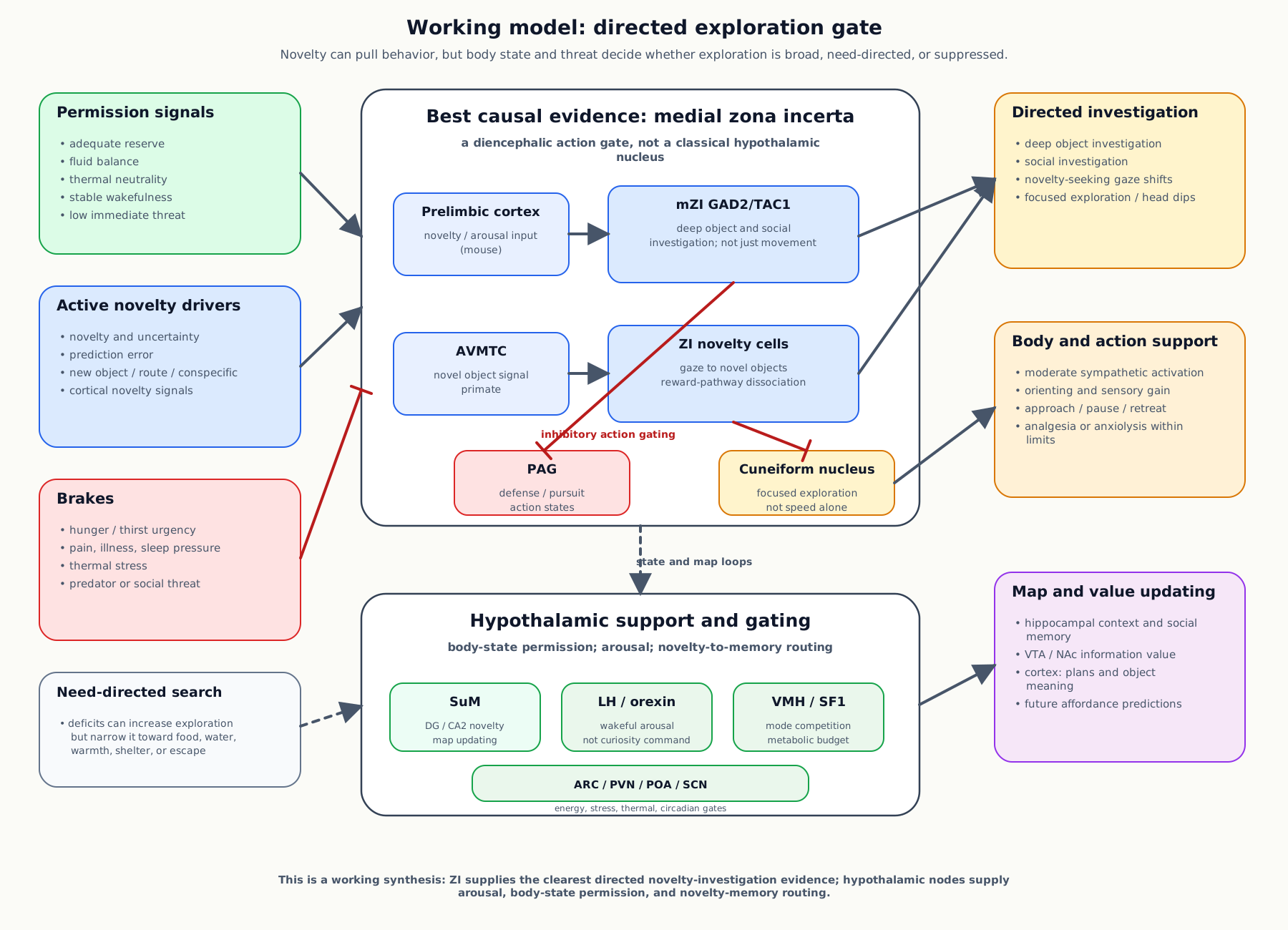
The useful way to summarize this circuit is by opposition and disinhibition. Acute bodily demands and danger impose brakes on open-ended exploration, although they can simultaneously drive narrower need-directed search. Physiological sufficiency and safety release some of those brakes. Novelty, uncertainty, and mismatch then provide an active pull. ZI helps route novelty and arousal into orienting and investigatory action. SuM links novelty and movement to hippocampal updating. LH/orexin helps energize the waking state without specifically commanding curiosity. Other hypothalamic circuits determine when competing bodily demands should interrupt. The result is not one behavior but a mode: awake, mobile, sensory sampling, cautious enough not to be reckless, and free enough from urgent need to learn.
The hard problem in studying exploration is separating curiosity from locomotion. A mouse that crosses the arena more often may be exploring, escaping, anxious, drug-activated, or simply hyperactive. The useful question is therefore not just how much did the animal move? It is what was the movement organized to accomplish?
Several experimental strategies help. Ahmadlou and colleagues distinguished shallow from deep investigation and asked whether animals preferentially investigated novelty rather than familiar objects, food, or prey. Sharma and colleagues compared focused exploratory actions with thigmotactic locomotion and showed that stimulating a medial ZI-to-cuneiform pathway increased exploration without simply increasing speed. Ogasawara and colleagues used gaze in monkeys and showed that ZI activity predicted choices that produced novel visual information even when novelty carried no extra reward.
These experiments illustrate a general methodological principle. Evidence for an exploration circuit becomes stronger when a manipulation changes directed information-seeking rather than simply increasing movement.
15.4 The affective and behavioral drive
Exploration becomes a drive when information itself acquires value. The animal does not merely receive novelty. It approaches, inspects, samples, and sometimes works to obtain it. That is why curiosity is not passive perception. It is perception organized as action.
The affective tone of exploration is state dependent. In a safe setting, a novel object may be attractive. In a threatening setting, the same object may be avoided. Under mild hunger, a new odor may be worth investigating as possible food. Under predator threat, novelty may still draw attention, but the behavior is defensive scanning rather than open-ended curiosity. This is an example of the broader principle of alliesthesia: the value of a stimulus changes with internal state.
Dopamine systems contribute to this motivational state, but it would be misleading to say that dopamine is curiosity. Dopaminergic neurons in the VTA and substantia nigra respond to reward prediction, salience, novelty, movement, and information-predictive cues, depending on the population and task. Through projections to the nucleus accumbens, striatum, hippocampus, and cortex, dopamine helps assign value to actions that may reveal useful information. But the primate ZI work is a useful warning against a one-system story. In that task, novelty seeking was not simply controlled by the lateral habenula and many substantia nigra dopamine neurons that classically encode reward prediction errors. Novelty can recruit reward-related systems, but it is not reducible to them.
Norepinephrine from the locus coeruleus can increase arousal and responsiveness to uncertainty. Acetylcholine can alter sensory and hippocampal processing during attention and learning. Orexin can stabilize the active waking state in which those systems operate. The nucleus accumbens and dorsal striatum help decide whether approaching, pausing, retreating, or sampling is worth the effort. Prefrontal and sensory cortical systems maintain goals, interpret objects, and compare the present scene with memory. The hypothalamus does not replace these systems. It biases them by reporting what kind of body is doing the exploring: hungry or sated, safe or threatened, rested or sleepy, thermally comfortable or stressed.
Exploration is therefore a positive drive but not an unbounded one. The animal is not simply maximizing novelty. It is regulating the value of information against cost. State and context determine whether novelty is approached, ignored, avoided, or evaluated according to a particular need.
For students, the important distinction is between randomness and uncertainty reduction. Exploration may look wandering because the animal does not yet know where the relevant information is. But the behavior is not random in the sense of being structureless. Animals orient to edges, openings, odors, objects, conspecifics, sounds, and landmarks. They pause, re-approach, compare, and habituate. They use movement to ask the world a sequence of questions. The questions are shaped by the body.
15.5 Effectors: movement, sampling, arousal, and model updating
The effectors of exploration are unusual because the output is not only a corrected body variable. In thirst, the decisive behavioral effector is drinking. In hunger, it is eating. In thermoregulation, it may be moving to shade, sweating, shivering, or brown-fat thermogenesis. In exploration, the output is a pattern of sampling that changes the animal’s future predictions.
The behavioral effectors are familiar from watching any animal enter a new space. It moves, pauses, orients, rears, sniffs, scans, circles, retreats, re-approaches, and samples surfaces or objects. Rodents whisk and sniff. Primates shift gaze and reach. Birds inspect with eyes, head movements, beak, and feet. Humans look, walk, touch, ask questions, test doors, examine tools, and remember landmarks. These are structured sampling movements that bring uncertain parts of the world into the senses.
Autonomic effectors support this sampling. Exploration usually requires moderate sympathetic activation: increased heart rate, vascular support for movement, respiratory adjustment, pupil dilation, and heightened sensory gain. It is not the maximal sympathetic surge of panic, but neither is it the quiet physiology of sleep or digestion. A useful exploratory state sits between immobility and emergency. Some hypothalamic, ZI, and PAG-related circuits can also modulate pain and anxiety during novelty exposure, which may help the animal tolerate the minor uncertainty that investigation requires. This should not be overstated; analgesia and anxiolysis are not the whole purpose of exploration. They are part of the bodily support that lets sampling proceed.
Endocrine outputs play a more indirect role. There is no pituitary hormone whose specific job is to make an animal curious. Instead, endocrine systems adjust the background state in which exploration becomes more or less likely. Low leptin and high ghrelin shift behavior toward food seeking. High stress-axis activation shifts behavior toward defense, vigilance, or withdrawal. Gonadal hormones can alter social and sexual investigation. Thyroid and metabolic signals affect energy availability and locomotor vigor. Circadian signals determine when the active phase should occur. Exploration is therefore regulated by endocrine state even though it is not commanded by a single endocrine effector.
The most distinctive effector is neural and computational: map updating. During exploration, hippocampal place cells, entorhinal grid and head-direction systems, cortical object representations, and striatal action-value systems update what the animal knows about the environment. Some of this updating happens during movement. Some is consolidated during pauses, quiet wakefulness, and sleep. The hypothalamus participates by stabilizing arousal, coupling movement to hippocampal state through SuM-related pathways, and gating whether bodily needs should interrupt the sampling process.
The correction produced by exploration is therefore delayed. The animal may not eat, drink, mate, or escape during the exploratory episode itself. The gain appears later, when a future deficit can be solved more efficiently because the animal already knows where to go, what to avoid, whom to approach, or which cue predicts change. In this sense, exploration is one of the most allostatic behaviors in the unit. It corrects a problem before the problem has a name.
The tradeoffs are equally important. Exploration costs energy. It exposes the animal to predators, injury, pathogens, toxins, social conflict, and getting lost. It can interfere with feeding, sleep, parenting, or hiding. Too little exploration leaves the animal trapped in a small, brittle world with poor predictions. Too much exploration becomes risk-taking, distractibility, or failure to exploit known resources. The adaptive solution is not maximum curiosity. It is regulated curiosity.
15.6 Clinical failures and human relevance
Clinical examples are useful here because they show that exploration can fail for different reasons. The failure is not always a lack of curiosity. Sometimes the body is too threatened, too tired, too sick, too poorly aroused, or too strongly pulled by novelty to let exploration serve its usual regulatory function.
In anxiety disorders, PTSD, and agoraphobic avoidance, threat systems keep the person in a defensive mode. The amygdala, BNST, stress axis, PAG, and autonomic systems bias the world toward danger. Exploration contracts. The person avoids places, routes, social situations, bodily sensations, or memories that might update the map. The tragedy is that avoidance can protect in the short term while preserving uncertainty in the long term. The world stays dangerous partly because it is no longer sampled under safer conditions.
In depression, anhedonia, and some forms of apathy, exploration can collapse from the opposite direction. The world may not feel worth sampling. Effort feels costly, novelty carries little promise, and future reward has weak motivational pull. This is not simply a cortical belief. Sleep, appetite, autonomic state, endocrine rhythms, pain, inflammation, and fatigue can all shift the bodily platform on which exploration depends. The result is a shrinking of behavioral range: fewer places visited, fewer actions initiated, fewer opportunities for the world to become informative again.
Narcolepsy provides a more specifically hypothalamic example. Degeneration of orexin neurons destabilizes wakefulness and produces sudden transitions into sleep or cataplexy. A person with narcolepsy may still be curious, intelligent, and motivated, but the arousal platform required for sustained outward exploration is unreliable. This clinical case reveals one reason the lateral hypothalamus belongs in the chapter. Exploration requires more than interest. It requires stable waking control.
ADHD is a useful but more cautious example. It should not be reduced to an excessive exploration drive. ADHD involves heterogeneous alterations in attention, arousal, executive control, timing, reinforcement sensitivity, and action regulation. Still, the disorder illustrates how novelty, boredom, effort, and switching can become dysregulated. Some individuals are pulled strongly toward new stimuli and away from low-novelty tasks, even when the familiar task is important. In control terms, the balance between exploiting the current goal and exploring the next possibility can become unstable.
Mania, addiction vulnerability, and high sensation seeking can be mentioned in the same cautious spirit. They show that novelty can be motivating and sometimes dangerous, but they should not be treated as direct readouts of a hypothalamic exploration circuit. Human exploratory behavior is shaped by development, social context, cognitive control, reinforcement history, and culture. The animal circuit work gives us useful architecture, not a one-to-one clinical translation.
Chronic pain, inflammatory illness, and sleep deprivation show the same architecture from another angle. Pain and sickness narrow the world because movement and uncertainty become costly. Sleep loss narrows the world because exploration cannot be sustained without arousal and cognitive control. In each case, the failure is not located in a single exploration center. It lies in the loop linking bodily state, threat, arousal, novelty, motivation, and map updating.
15.7 Integration: exploration as predictive control
This unit began with the hypothalamus as a body-regulation system: a small, ancient structure that reads the state of the body and converts bodily need into autonomic, endocrine, and behavioral action. Exploration might seem, at first, to sit at the edge of that story. It is not obviously about water, calories, heat, sleep, stress, or reproduction. It is outward-looking. It concerns the world.
But that is exactly why it belongs at the end. A regulated body does not merely correct today’s errors. It improves tomorrow’s control problem. Exploration discovers the affordances that later systems will use: water sources for thirst, food patches for hunger, shade and shelter for thermoregulation, escape routes for defense, social partners for reproduction and care, familiar paths for efficient movement, and safe places for sleep. It converts the unknown environment into a set of usable predictions.
Exploration is therefore best understood as state-gated rather than as the output of a dedicated curiosity center. Bodily state helps determine whether novelty should be sampled broadly, searched for a specific need, treated as possible danger, or ignored because another demand is more urgent. Hypothalamic and neighboring diencephalic circuits contribute to this gating by linking metabolic state, arousal, threat, movement, novelty, and hippocampal updating.
Exploration is not the opposite of regulation. It is regulation extended into the future. The animal samples the world so that later hunger, thirst, cold, danger, mating opportunity, or social need will not arrive as complete surprises. The chapter’s strongest synthesis is also its most speculative: exploration can be understood as the regulated body’s investment in future allostasis. If the other chapters showed how the hypothalamus turns bodily need into action, this chapter shows how a body with its immediate needs sufficiently managed can turn outward and learn what future action will be possible.