12 Aggression and Defense
The Regulated Body
12.1 The adaptive problem: protecting the body before contact
Aggression and defense are different from the regulatory systems we have considered so far because the variable being defended is not a concentration in the blood or a temperature in the body core. What is being defended is a margin of safety: distance from injury, predation, social defeat, loss of resources, and threats to offspring or mating opportunity. The problem is still bodily regulation, but the regulated body is now being protected by controlling its relation to the outside world. An animal survives not only by keeping glucose, water, and temperature within useful ranges, but also by keeping teeth, claws, rivals, and hostile groups far enough away that those internal variables can keep being defended tomorrow.
This makes the feedback problem especially severe. In thirst, waiting too long means plasma osmolarity rises and the animal becomes impaired. In thermoregulation, waiting too long means the body cools or overheats. In defense, waiting for definitive feedback can mean waiting until the predator has struck or the rival has already won. The error signal may be tissue damage. That is much too late. Defensive control therefore has to be predictive from the start. A looming object, a predator odor, an unfamiliar conspecific in the home territory, the memory of a dangerous place, or the posture of a dominant rival can shift the animal into a defensive or aggressive mode before contact occurs.
The behavioral problem is also more complex than a simple choice between fight and flight. Freezing can avoid detection. Flight can create distance. Threat display can end a conflict without injury. Submission can prevent further attack. Offensive aggression can defend territory, food, mates, or offspring. Predatory attack is different again, because the target is prey rather than a social rival. These actions are mutually incompatible. A body cannot freeze, flee, attack, court, feed, and groom with full commitment at the same instant. The controller must select a mode, scale its intensity, and change modes quickly when the situation changes.
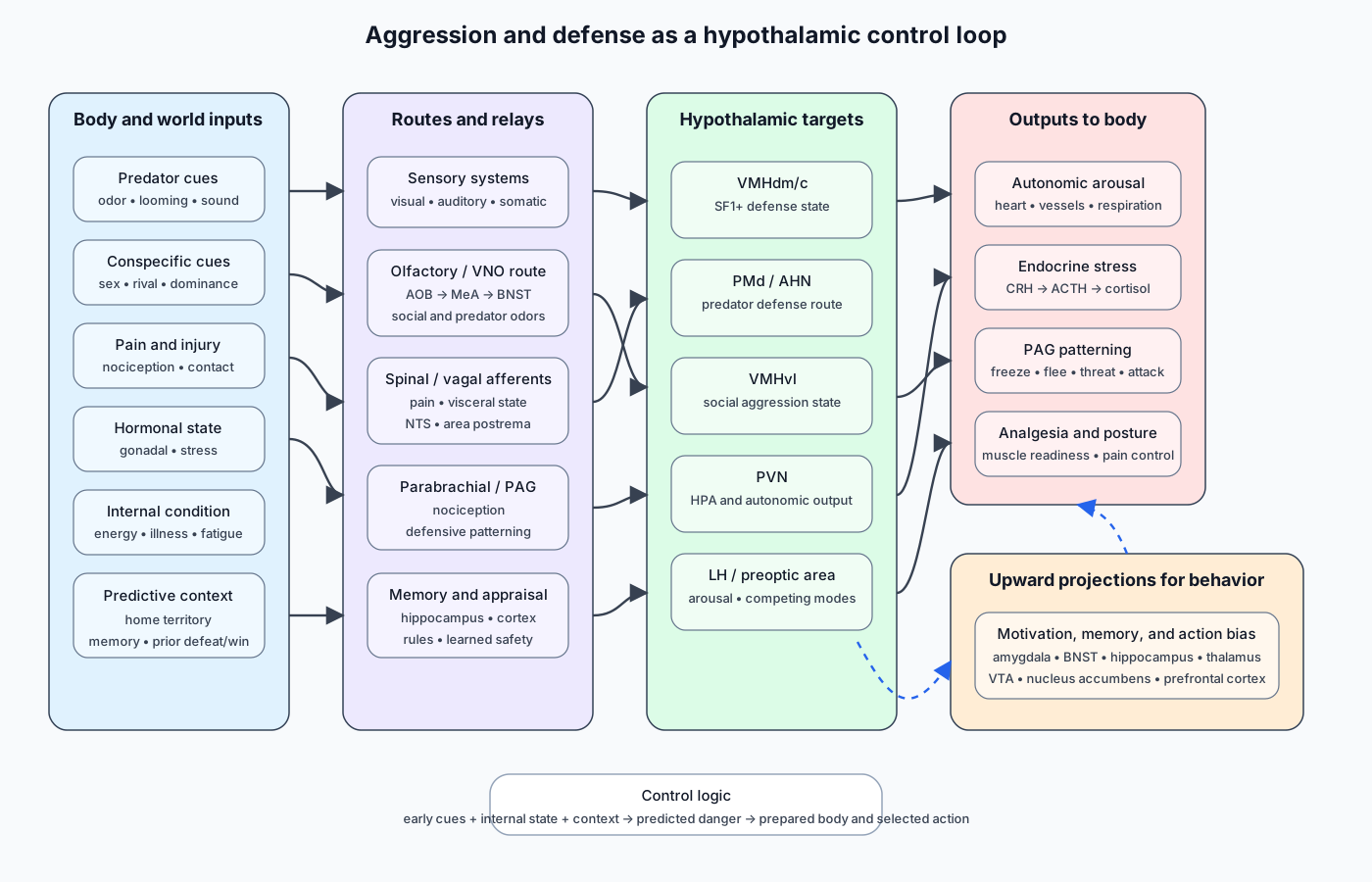
The hypothalamus is central to this selection, but not because it contains a single aggression center or fear center. The medial hypothalamus is better understood as a set of state-control nodes embedded in larger loops. Sensory systems identify danger or social opportunity. The amygdala, BNST, septum, hippocampus, and cortex provide social meaning, sustained threat, inhibition, context, and learned prediction. The hypothalamus integrates those signals with the animal’s internal state and biases the body toward a survival program. Brainstem systems, especially the periaqueductal gray, then help pattern the action. The chapter is about that loop: how the brain turns possible danger into autonomic arousal, endocrine preparation, and organized behavior before the body is harmed.
12.2 Sensors and signals: detecting danger, rivals, and context
The aggression-defense system samples the world through several routes at once. Some signals identify the category of threat. Others report the condition of the body. Still others specify where the animal is, what happened there before, and what the current social situation means. The hypothalamus does not receive a single “danger signal.” It receives a changing pattern of evidence that must be interpreted in light of bodily state and context.
12.2.1 Fast predictive cues
The fastest cues are environmental. A rapidly expanding visual stimulus can signal an approaching object or aerial predator. In rodents, visual looming information can recruit midbrain and amygdala-related defensive pathways before there is time for detailed cortical interpretation. Predator odors provide another class of early warning. These odors are processed through olfactory and vomeronasal routes, with strong access to the medial amygdala and BNST, and from there to medial hypothalamic defensive systems. Pain and nociceptive signals provide more direct evidence that the body has been contacted or injured; they reach the brain through spinal pathways, parabrachial relays, and periaqueductal gray circuits that can rapidly reorganize action.
Conspecific cues are equally important, but they are not interpreted in the same way as predator cues. In many mammals, pheromonal and other chemosensory signals from another animal pass through the accessory olfactory bulb and medial amygdala before influencing the hypothalamus. These cues carry information about sex, reproductive state, familiarity, dominance, and territorial intrusion. A male intruder in a resident male’s territory, a receptive female, an unfamiliar juvenile, and a predator odor may all activate overlapping sensory structures, but they require different responses. The circuit must therefore classify the cue and select the relevant social mode.
In humans and other visually oriented primates, the sensory surface is different. Faces, gaze direction, body posture, vocal tone, approach speed, and the remembered identity of another person can all predict threat or safety. That does not make the hypothalamus irrelevant. It means that cortical and limbic systems have more influence over the evidence that reaches hypothalamic and brainstem survival circuits. The ancient control problem remains: decide whether the body should be prepared for confrontation, escape, appeasement, or social contact.
12.2.2 Internal state and threshold signals
Internal state changes the threshold for defensive and aggressive modes. Gonadal hormones are a major example. Testosterone, estradiol, and progesterone do not simply “cause aggression.” They alter the gain of social circuits, especially in reproductive and territorial contexts, by acting on receptors in the medial amygdala, BNST, VMHvl, preoptic area, and related regions. A cue that is ignored in one hormonal state may become salient in another. The same sensory input is therefore read differently depending on reproductive condition, sex, season, and recent social experience.
Stress hormones also reshape the system. Acute threat activates the HPA axis and sympathetic nervous system, preparing the body for action. But high or chronic glucocorticoid states can change defensive thresholds, promote vigilance or withdrawal, and interfere with flexible social behavior. Energy state matters as well. A starving animal may avoid costly fights unless the conflict concerns food; a well-fed animal may be more willing to patrol territory or defend offspring. Sleep loss, illness, inflammation, pain, and fatigue can all shift the balance between exploration, avoidance, irritability, and attack. These are not separate “psychological” overlays. They are body-state variables that alter the controller’s setting.
Some of these signals reach the hypothalamus through the blood. Steroid hormones cross into the brain and act on intracellular receptors. Glucocorticoids feed back to hypothalamus, hippocampus, amygdala, and prefrontal cortex. Cytokines and illness signals can influence brainstem and hypothalamic circuits through humoral routes and through vagal and spinal afferents. Unlike fluid balance, there is no single circumventricular organ whose job is to measure “danger.” Instead, endocrine, immune, visceral, nociceptive, and sensory evidence converges on distributed threat-control circuits.
12.2.3 Context, memory, and learned prediction
Context is often the difference between an adaptive response and a disastrous one. A conspecific in the home cage may be an intruder; the same conspecific in a neutral arena may not be. A place where the animal was previously attacked can become dangerous even before any attacker appears. The hippocampus contributes spatial and contextual memory. Prefrontal and orbitofrontal regions help use rules, expected outcomes, and social consequences. The amygdala and BNST help assign threat value, especially when danger is uncertain or sustained.
This is where defense becomes unmistakably allostatic. The animal is not merely reacting to a stimulus. It is using the stimulus, the setting, and past experience to forecast what may happen next. Prior defeat can lower the threshold for freezing or avoidance. Prior victory can increase the probability of approaching or attacking a rival. Maternal state can make an otherwise avoidable threat worth confronting. Learned safety can suppress defensive output even in the presence of a cue that once predicted harm. The same body therefore responds differently because its controller has a different prediction.
12.3 Hypothalamic circuits: defensive and aggressive state control
The medial hypothalamus contains several interconnected zones that are repeatedly recruited during species-typical defense and aggression. The important point is not that each zone is a labeled center for a single behavior. The important point is the circuit logic. Different streams of evidence bias different hypothalamic populations; inhibitory pathways keep incompatible modes from running at the same time; and descending projections to the midbrain and brainstem translate state selection into action patterns.
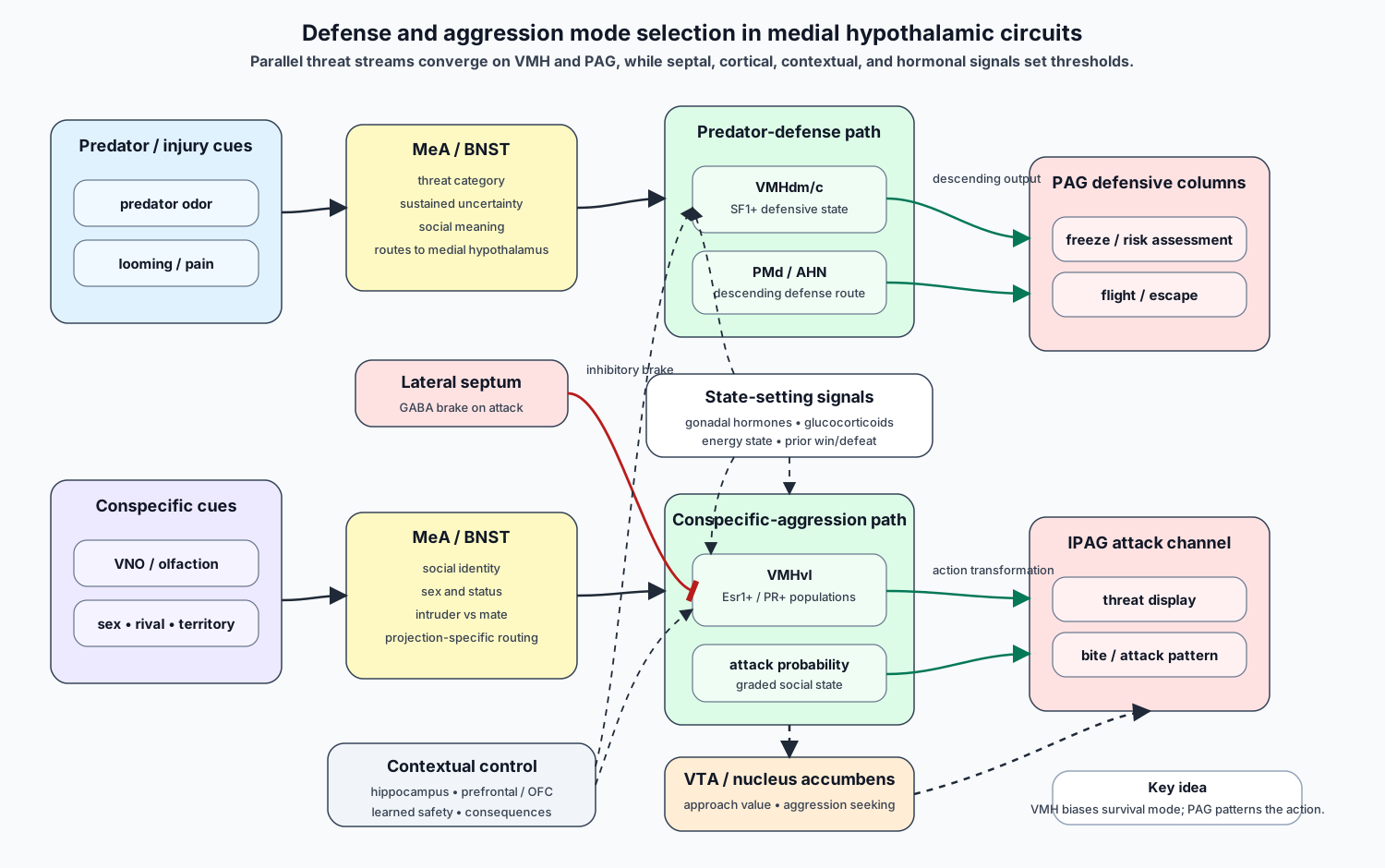
A useful first division separates predator defense from conspecific aggression. Predator defense is strongly associated with the dorsomedial and central parts of the ventromedial hypothalamus, often written VMHdm/c, and with the dorsal premammillary nucleus, PMd. Conspecific aggression is strongly associated with the ventrolateral subdivision of the ventromedial hypothalamus, VMHvl. This division is real enough to be useful, but it is not absolute. Defensive threat, territorial aggression, mating, parental defense, and social investigation all recruit partially overlapping forebrain and hypothalamic systems. The same region can contain intermingled populations with different molecular markers, projections, and behavioral correlates.
12.3.1 Predator defense: VMHdm/c, PMd, and the medial hypothalamic defensive system
Predator defense begins with early identification of danger. Odor, visual looming, unfamiliar movement, pain, and contextual memory can all feed into defensive pathways. The medial amygdala and BNST help route predator-related cues toward the medial hypothalamic defensive system. Within that system, VMHdm/c and PMd are especially important for antipredator responses such as freezing, flight, risk assessment, and avoidance.
Older lesion studies already showed that damage to the dorsal premammillary region can greatly reduce defensive responses to predators while sparing other behaviors. Modern causal tools refined that picture. Optogenetic activation of genetically defined SF1-expressing neurons in VMHdm/c can produce defensive behaviors even in an otherwise safe setting, and activity in these neurons scales with threat. That result is important pedagogically because it shows that the hypothalamus is not merely a passive output stage for the amygdala. It can help instantiate the defensive state itself: a mode in which sensory processing, autonomic arousal, posture, movement, and future action are all biased toward survival.
PMd then provides a major descending route toward the periaqueductal gray and other brainstem defensive systems. The PAG does not simply relay commands to muscles. It helps organize survival patterns. Depending on the column and context, PAG circuits contribute to freezing, flight, defensive vocalization, analgesia, changes in respiration, and cardiovascular adjustments. The hypothalamus helps set the mode; the PAG and lower brainstem help implement it.
12.3.3 Brakes, gates, and competing modes
A system this powerful requires brakes. The lateral septum is one of the clearest examples. It sends inhibitory influence to the medial hypothalamic aggression system, including VMHvl-related circuitry. Activating lateral septal projections can suppress ongoing attack, while disrupting them can release aggression. This does not mean the lateral septum is simply a peace center. It means that social behavior depends on inhibitory gating. Attack must be available when needed, but it must also be held below threshold when the situation calls for mating, investigation, parental care, submission, or disengagement.
Other gates operate at different levels. The medial amygdala and BNST help determine what kind of social or threat cue is being processed. The hippocampus supplies context: home territory, unsafe place, familiar location, remembered defeat. Prefrontal and orbitofrontal systems help incorporate rules, consequences, and social expectations, especially in humans. The preoptic area can bias parental and reproductive modes. Lateral hypothalamic, VTA, and nucleus accumbens circuits can make aggressive approach more or less motivationally attractive. These systems do not merely “modulate” a hypothalamic command. They help decide which command is appropriate.
Inhibition is also important because survival modes compete. Feeding is suppressed during immediate danger. Courtship can be interrupted by threat. Freezing must give way to flight if the predator closes in. Attack must stop if the opponent submits or if injury risk becomes too high. The hypothalamus participates in these state switches by integrating cue category, internal state, hormonal gain, and contextual prediction. This is why lesion studies that once appeared to reveal simple centers often produced broad behavioral changes. Damaging a node in a state-control network disrupts transitions, thresholds, and sequences, not just one isolated act.
12.3.4 Causal evidence
The modern evidence is powerful because it moves beyond correlation. Immediate-early-gene mapping showed that particular hypothalamic populations are active during defense or aggression. Electrophysiology and calcium imaging then showed how activity changes as animals investigate, threaten, attack, flee, or freeze. Optogenetic and chemogenetic manipulations provided causal tests: activating VMHdm/c SF1 neurons can evoke defensive responses; manipulating VMHvl can promote or suppress aggression; stimulating lateral septal inputs can inhibit attack; and projection-specific work from VMHvl to PAG shows how a hypothalamic state signal is transformed into an action pattern.
The lesson is not that modern tools finally discovered the true fear center or aggression center. The lesson is that hypothalamic neurons are embedded in circuits that compute when a survival mode should become active. These experiments are best read as control experiments in the engineering sense: change the gain of one node, silence a brake, activate a projection, and watch how the whole system’s threshold and output change.
The phrase “attack switch” is memorable, but it is too simple for the biology. VMHvl stimulation can evoke attack under some conditions, and silencing VMHvl can stop ongoing aggression. Those findings establish causal leverage. They do not mean that a single nucleus contains a complete command for violence.
Several facts argue for the richer interpretation. VMHvl contains intermingled cell populations. Some are more active during male investigation, some during attack, some during mating-related behaviors, and some vary with hormonal state or social experience. The effect of stimulation depends on intensity and context. A resident male, a receptive female, an anesthetized animal, a juvenile, and an inanimate object are not equivalent inputs to the circuit. Downstream structures such as PAG are needed to organize the motor pattern, while upstream structures such as medial amygdala, BNST, septum, hippocampus, and cortex help decide what the social cue means.
The better formulation is this: VMHvl is a powerful node in a social action-selection system. It can bias the animal toward attack when the larger circuit state supports that interpretation, but aggression emerges from the loop, not from a button.
12.4 The Affective and Behavioral Drive
A defensive or aggressive state is not just a motor program. It changes what the animal is prepared to notice, value, and do. When threat prediction is high, the environment is parsed for escape routes, cover, movement, and danger. When territorial aggression is high, the same environment may be parsed for intruders, boundaries, and opportunities to threaten or attack. The hypothalamus contributes to this shift by coupling body preparation to motivational priority.
This is where affect enters the story. Fear, anger, vigilance, irritability, and dominance motivation are not identical to hypothalamic activity, and they should not be reduced to it. But they are bodily and behavioral states, not disembodied feelings floating above physiology. Sympathetic arousal, HPA-axis activation, muscle readiness, analgesia, facial or postural expression, and biased attention are part of what makes a state feel urgent. The hypothalamus helps assemble that urgency by coordinating autonomic, endocrine, and behavioral outputs while sending signals into wider telencephalic systems.
The upward routes matter. Amygdala and BNST circuits help maintain threat value, especially when danger is uncertain. Hippocampal circuits tie defensive state to place and context. Thalamic and cortical systems shape perception and action planning. VTA and nucleus accumbens circuits can assign motivational value to approach, including aggressive approach in some contexts. This is why aggression can become more likely after prior victories. Winning does not simply strengthen a muscle reflex. It can change the expected value of confrontation, the animal’s confidence in a successful outcome, and the threshold for entering an aggressive mode.
The same logic explains why prior defeat can produce avoidance, freezing, or social withdrawal. The sensory cue is not interpreted in isolation. It is interpreted against a model of what happened before and what is likely to happen next. A neutral animal may become a predicted threat. A familiar context may become unsafe. A slight provocation may be assigned more significance than it deserves. The regulatory state changes the animal’s world by changing which affordances stand out: escape, attack, appeasement, hiding, guarding, or seeking help.
This is not an argument that fear and anger are “in the hypothalamus.” It is an argument that affective states are organized around bodily control. The hypothalamus helps convert predicted danger into a body ready for action, and the rest of the brain turns that readiness into perception, memory, valuation, and choice.
12.5 Effectors: arousal, hormones, and patterned action
The outputs of the aggression-defense system can be grouped into three broad arms: autonomic preparation, endocrine regulation, and behavioral patterning. These arms are coordinated, but they operate on different timescales.
The autonomic arm is fast. Hypothalamic and brainstem pathways increase sympathetic outflow, raising heart rate, blood pressure, respiratory drive, and glucose mobilization. Blood flow is redistributed toward skeletal muscle. Pupils dilate. Sweating or piloerection may occur depending on species. Pain sensitivity can be reduced through descending analgesic systems. These responses do not decide whether to freeze or attack by themselves. They prepare the body so that whichever action is selected can be executed with speed and force.
The endocrine arm is slower but more sustained. Threat activates the HPA axis: hypothalamic CRH neurons drive pituitary ACTH release, which stimulates glucocorticoid secretion from the adrenal cortex. Glucocorticoids help mobilize fuel and stabilize the body during challenge, but prolonged activation carries costs for immunity, metabolism, sleep, mood, and cognition. Gonadal hormones act on a still longer horizon. They help set seasonal, reproductive, and social thresholds for aggression, mating, parental defense, and withdrawal. The same hormones that serve as inputs to the circuit can therefore also be considered part of the effector loop, because defensive and social states feed back onto endocrine regulation.
The behavioral arm is patterned through hypothalamic projections to PAG, reticular formation, cranial motor nuclei, and spinal systems. Freezing reduces detection and movement noise. Flight increases distance. Risk assessment samples the environment while limiting exposure. Threat displays may end a conflict without physical injury. Attack can defend territory, mates, food, or offspring, but it risks wounds and retaliation. Submission or appeasement can be the least costly solution when winning is unlikely. The value of each action depends on context, and the cost of selecting the wrong one can be severe.
PAG organization is useful here, provided it is not treated too rigidly. Dorsal and lateral PAG regions are often associated with active defensive responses such as flight or confrontational defense, whereas ventrolateral PAG is strongly associated with freezing and passive coping. Lateral PAG and adjacent circuits contribute to attack-related patterns, including biting. But these columns interact, and real behavior is dynamic. An animal may freeze, orient, flee, turn, threaten, and attack in a sequence that depends on distance, escape routes, prior experience, and internal state.
The tradeoffs are the point. Defense protects the body but consumes energy, interrupts feeding, disrupts sleep, suppresses reproduction, and can damage social relationships. Aggression may preserve resources or offspring, but it can produce injury and escalate conflict. The hypothalamus helps coordinate these expensive responses only when the predicted benefit exceeds the cost.
12.6 Clinical failures and human relevance
Human aggression and defense cannot be mapped directly onto mouse VMHvl or VMHdm/c circuitry. Humans use language, norms, law, culture, long-term planning, and explicit self-control. But the clinical disorders are still useful because they reveal the same architectural principles: threat prediction, bodily arousal, contextual regulation, inhibitory control, and the ability to stop a response when the situation changes.
Post-traumatic stress disorder is a disorder of threat prediction as much as a disorder of memory. After trauma, cues that resemble the original danger can evoke defensive readiness even when the present context is safe. The human evidence emphasizes amygdala, hippocampus, medial prefrontal, dorsal anterior cingulate, and insular systems, with downstream effects on autonomic and endocrine arousal. The hypothalamus is part of that downstream body-control machinery, especially through HPA-axis and autonomic pathways. The control failure is not simply “too much fear.” It is a biased predictive system that treats safety cues as unreliable and keeps the body prepared for danger.
Intermittent explosive disorder and related forms of impulsive reactive aggression illustrate a different failure. Here the problem is not sustained traumatic vigilance but the rapid escalation of anger and attack-like behavior out of proportion to the provocation. Human imaging and lesion evidence point strongly to frontolimbic regulation: amygdala and threat-reactivity systems are insufficiently constrained by orbitofrontal, ventromedial prefrontal, and anterior cingulate control. In the language of this chapter, the brakes and contextual gates fail to restrain a defensive-aggressive mode before it becomes action.
Hypothalamic lesions and hypothalamic hamartomas provide a more direct but rarer window into the architecture. Depending on location and associated seizure activity, hypothalamic pathology can produce disturbances of rage, laughter, autonomic state, endocrine regulation, sleep, appetite, or sexual behavior. These cases should be treated cautiously because lesions are rarely clean and symptoms often involve broader networks. Still, they remind us why the hypothalamus belongs in a chapter on behavior. Damage to body-regulation nodes can alter not only hormones and temperature, but also the organization of action.
Hormonal manipulation is also instructive. In many species, gonadal steroids modulate aggression thresholds in reproductive and territorial contexts. In humans, the relationship between testosterone and aggression is variable and strongly shaped by context, personality, status, and social norms. Abuse of anabolic-androgenic steroids can increase irritability and aggression in some individuals, but it should not be explained as simple activation of a human attack center. The safer conclusion is that steroid state can change the gain of social and affective circuits, making some individuals more reactive to provocation while leaving others largely unaffected.
These examples break different parts of the loop. PTSD alters prediction and contextual safety learning. Impulsive aggression alters braking and social appraisal. Hypothalamic pathology can disrupt the state-control machinery itself. Hormonal manipulation changes gain. The common lesson is that aggression and defense are not moral abstractions floating free of biology. They are regulated states built from sensors, predictions, thresholds, body preparation, and behavioral choices.
12.7 Integration: aggression and defense as predictive control
Aggression and defense show allostasis in its most urgent form. The body cannot wait for definitive feedback because definitive feedback may be injury, predation, or defeat. The system therefore uses early cues — odor, motion, pain, posture, context, memory, social identity, reproductive state, stress state, and prior experience — to estimate what kind of danger is likely and what response will be least costly.
The hypothalamus is central because it sits at the point where those predictions become bodily commands. VMHdm/c and PMd help organize antipredator defense. VMHvl helps organize conspecific aggression and social action selection. PVN and related hypothalamic systems mobilize endocrine and autonomic responses. Lateral septum, BNST, amygdala, hippocampus, prefrontal cortex, VTA, nucleus accumbens, PAG, and brainstem systems gate, motivate, contextualize, and execute the response. The result is a distributed loop, not a center.
Seen this way, aggression and defense belong squarely in a unit on the regulated body. They defend the body’s future by changing the animal’s relation to the world. The same predictive logic that silences thirst before water is absorbed and shifts hunger before calories arrive also prepares the body for danger before contact occurs. The hypothalamus does not merely react after the body is damaged. It helps decide, in advance, whether the body should hide, flee, threaten, fight, submit, or return to safety.