8 Fluid Balance and Thirst
The Regulated Body
8.1 The adaptive problem: defending the internal ocean
Life evolved in water, and every cell still depends on an aqueous environment whose composition is tightly controlled. On land, that internal ocean is always at risk. Water is lost continuously through breathing, sweating, urination, and defecation, while intake is episodic and often uncertain. Energy can be stored for weeks, but body water cannot. Even small changes in plasma osmolarity — on the order of one to two percent — alter neuronal excitability and produce an urgent motivational state: thirst.
The central problem is not simply detecting dehydration. It is preventing oscillation. Water that enters the mouth does not immediately restore the blood. It must pass through the stomach and intestine, be absorbed into the circulation, and then redistribute through body compartments. That delay creates the same control problem we saw in thermoregulation. A system that waited for blood chemistry to normalize before turning thirst off would overshoot badly, diluting plasma sodium and risking cerebral edema. A system that waited for a large osmotic error before turning thirst on would allow the brain to operate in an impaired state.
Fluid balance therefore requires predictive control. The brain must read the current state of the blood, but it must also interpret early cues that forecast future correction. Drinking is regulated not only by what the blood is now, but by what the body predicts the blood will be after the swallowed water has been absorbed. In this chapter, fluid balance becomes our second major example of hypothalamic allostasis: the regulated variable is chemical rather than thermal, but the logic is the same.
8.2 Sensors and signals: osmotic, volumetric, and ingestive evidence
Fluid balance depends on three streams of information. One reports the concentration of the blood. A second reports the effective volume of the circulation. A third reports that ingestion has begun and that correction is on the way. These signals differ in what they measure and in how early they arrive, and the hypothalamus treats them accordingly.
8.2.1 Osmotic sensing: direct access to the blood
The most direct signal is osmolarity — the concentration of dissolved solutes relative to water. When water is lost without equivalent solute loss, extracellular fluid becomes hypertonic. Water leaves cells, neurons shrink, and the brain must defend against the resulting change in excitability.
The key sensors lie in circumventricular structures near the anterior wall of the third ventricle, especially the organum vasculosum of the lamina terminalis (OVLT) and the subfornical organ (SFO). As described in the unit overview (Section 6.4), these regions lack a normal blood–brain barrier, allowing neurons and glia to sample circulating ions and hormones directly. Their cells are intrinsically osmosensitive. As extracellular fluid becomes hypertonic, cell shrinkage and sodium-sensitive mechanisms alter membrane conductance through osmosensitive channel systems, including TRPV-family mechanisms and Nax-dependent sodium sensing. The result is a graded increase in firing that converts the physical state of the blood into a neural signal for dehydration.
This is feedback in the strict sense: the blood has already changed. But because the OVLT and SFO sit at the blood–brain interface, the signal is rapid and chemically precise. They tell the brain that the internal ocean has become too concentrated and that water must be conserved and replaced.
8.2.2 Volume sensing: pressure, kidney, and angiotensin II
A second error signal concerns effective circulating volume: whether there is enough fluid in the vascular system to maintain blood pressure and tissue perfusion. Osmolarity and volume often change together, but they are not the same variable. Sweating can raise osmolarity with only modest volume loss. Hemorrhage can produce dangerous volume loss before osmolarity has changed much at all. The brain must distinguish these conditions because they demand different corrective behaviors.
Volume loss is detected first by peripheral sensors. Baroreceptors in the carotid sinus and aortic arch respond to stretch in the vessel wall. When blood pressure falls, their firing decreases, and this information reaches the nucleus of the solitary tract (NTS) through the glossopharyngeal and vagus nerves. At the same time, reduced renal perfusion activates the renin–angiotensin system. The kidney releases renin, renin helps generate angiotensin II, and angiotensin II acts on circumventricular organs, especially the SFO, because it cannot freely cross the blood–brain barrier.
Angiotensin II is therefore both a hormonal signal and a control signal. It tells the brain that the deficit is not merely osmotic but volumetric. Pure osmotic dehydration mainly calls for water. Hypovolemia often calls for water plus sodium, because restoring volume with water alone can worsen the dilution of plasma sodium. This distinction becomes crucial when we turn to sodium appetite below.
8.2.3 Ingestive sensing: prediction before absorption
The third signal is neither a measure of osmolarity nor a measure of volume. It is evidence that correction is under way.
Thirst neurons begin to shut down within seconds after drinking starts, long before swallowed water can reach the bloodstream. This rapid inhibition is driven by pre-absorptive signals from the mouth, throat, and upper gastrointestinal tract. Cool water in the oral cavity, the mechanics of swallowing, and the early distension of the stomach all report that fluid is being ingested. These signals reach the forebrain through brainstem relays, including the parabrachial nucleus and NTS, and they are routed to the lamina terminalis network.
These cues do not say that the body has been restored. They say that restoration is likely. In control-theory terms, they are feedforward signals for impending correction. The brain uses them to terminate thirst before the blood has actually normalized. This early shutdown prevents overdrinking and shows why thirst is not a simple reflex triggered by blood chemistry. It is a predictive computation built from present error and expected future repair.
8.3 Hypothalamic circuits: the lamina terminalis controller
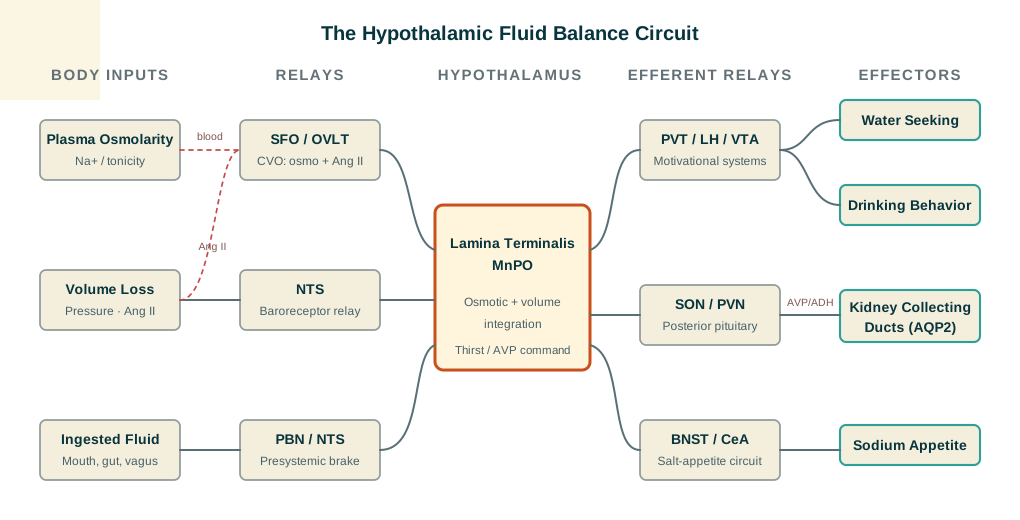
The core circuitry for thirst lies along the lamina terminalis, the thin anterior wall of the third ventricle. Its main components form a compact but powerful control network: the SFO dorsally, the OVLT ventrally, and the median preoptic nucleus (MnPO) between them. The SFO and OVLT provide privileged access to the blood; the MnPO integrates those blood-borne signals with neural reports from the mouth, gut, kidney, and cardiovascular system.
As with the preoptic area in thermoregulation, it is tempting to call this a “thirst center,” but that phrase is too crude. The lamina terminalis does not merely switch drinking on. It estimates the type and magnitude of the fluid error, regulates vasopressin release, assigns motivational urgency to water seeking, and terminates drinking when early sensory evidence predicts that the deficit will be corrected. It is a controller, not a button.
8.3.1 The excitatory drive: SFO and OVLT
The excitatory limb of the circuit begins with osmosensitive and angiotensin-sensitive neurons in the SFO and OVLT. When plasma becomes hypertonic, or when angiotensin II signals reduced volume, these neurons increase their firing and project to the MnPO. The MnPO then routes the signal along two major outputs.
One output is endocrine. The MnPO and related lamina terminalis neurons influence magnocellular neurons in the supraoptic nucleus (SON) and paraventricular nucleus (PVN), which release vasopressin from the posterior pituitary. Vasopressin acts on the kidney to conserve water before any new water has been found. The other output is motivational. Projections to hypothalamic, thalamic, and limbic targets — including the lateral hypothalamus and paraventricular thalamus — help energize the behavioral sequence of searching for water, approaching it, and drinking.
8.3.2 The inhibitory brake: mouth, throat, and gut
The same network also contains the braking system that stops drinking early. The first brake is immediate and presystemic. Oropharyngeal signals produced by drinking inhibit thirst neurons within seconds. The second brake is slower but more informative. As water enters the small intestine, gut osmosensors report its hypotonicity through vagal pathways to the NTS, which then influences the lamina terminalis.
The two brakes solve different parts of the timing problem. Mouth and throat signals stop the drive quickly, preventing the animal from drinking continuously while it waits for absorption. Gut signals sustain that inhibition if the ingested fluid really is capable of correcting the deficit. A mouthful of seawater or hypertonic fluid may satisfy the immediate mechanics of drinking, but it does not provide the same intestinal evidence that useful water has arrived.
Together, these inputs allow the MnPO to compute a running estimate of future hydration. Excitatory signals from the blood report the present deficit. Inhibitory signals from the mouth and gut report the correction already in progress. Drinking stops when the predicted correction is sufficient, not when every cell has already been rehydrated.
8.3.3 Causal evidence
Modern causal methods have made this architecture unusually clear. Oka and colleagues showed that activating excitatory CaMKIIα-positive neurons in the SFO is sufficient to drive intense drinking even in water-replete mice. The behavior is selective: stimulation promotes water intake rather than feeding or generalized arousal. This identifies a labeled excitatory pathway for thirst.
Betley and colleagues added an important affective dimension. Activation of lamina terminalis thirst neurons is aversive; animals work to turn the signal off. This means that thirst is not simply a sensory report that the blood is concentrated. It is a negative motivational state that organizes behavior around relief. The animal drinks because drinking predicts the termination of a biologically meaningful error signal.
Augustine and colleagues then clarified the hierarchy of the circuit. Stimulating the MnPO can drive drinking, whereas inhibiting the MnPO blocks drinking induced by SFO activation. This places the MnPO downstream of the SFO as a critical bottleneck for behavioral output. Zimmerman and colleagues completed the predictive picture with fiber photometry, showing that thirst neurons in the SFO and MnPO fall silent almost immediately when drinking begins and are later regulated by gut-derived signals about the osmotic content of the ingested fluid.
Taken together, these studies show a complete control loop. The lamina terminalis detects osmotic and volumetric need, generates an aversive drive state, recruits endocrine and behavioral effectors, and then shuts that drive down using sensory evidence that the correction is under way.
8.4 The Affective and Behavioral Drive
Physiological conservation can buy time, but it cannot solve the central problem. No kidney, however efficient, can manufacture water. At some point the animal must act. This is why thirst is one of the clearest cases in which a hypothalamic signal becomes a motivated behavioral state.
Thirst has an affective quality. It is unpleasant when water is needed, and drinking is powerfully relieving. The same water that would be neutral when you are hydrated becomes intensely appealing when you are dehydrated. This state-dependent change in value is a form of alliesthesia: the pleasantness or unpleasantness of a stimulus depends on the internal state of the body. Thermal comfort worked this way in the previous chapter. Fluid balance does as well.
This affective transformation is not an embellishment added by the cortex after the hypothalamus has done the “real” regulation. It is part of the regulatory solution. A chemical deviation in the blood has to be converted into a behavioral priority strong enough to interrupt whatever else the animal is doing. The hypothalamus and lamina terminalis supply the bodily urgency; downstream motivational systems help turn that urgency into seeking, approach, and consumption. The subjective experience of thirst is therefore not separate from regulation. It is one way regulation becomes behavior.
8.5 Effectors: conserving water, drinking, and salt appetite
Fluid balance is defended through a hierarchy of effectors. The first response is physiological conservation. Magnocellular neurons in the SON and PVN release vasopressin, also called antidiuretic hormone, from the posterior pituitary. Vasopressin acts on V2 receptors in the kidney collecting ducts, promoting insertion of aquaporin-2 water channels. More water is reabsorbed into the blood, urine becomes concentrated, and further loss is minimized.
This endocrine response is powerful, but it is temporary. It reduces the rate of loss; it does not replace what has already been lost. The definitive correction is behavioral drinking. By driving water seeking and ingestion, the brain reaches outside the body to restore the regulated variable. As in thermoregulation, behavior is often the most efficient effector because it changes the animal’s relation to the environment rather than forcing physiology to compensate internally.
A third response is required when the problem is volume depletion rather than pure water loss: sodium appetite. If an animal has lost extracellular fluid containing salt, drinking only water can be dangerous because it dilutes plasma sodium while failing to restore the correct extracellular composition. The brain must therefore sometimes promote salt intake along with water intake.
Salt appetite depends on circuitry that partially overlaps with thirst but is not identical to it. A key population lies in the NTS: HSD2 neurons, named for their expression of 11β-hydroxysteroid dehydrogenase type 2. These neurons are sensitive to aldosterone, a steroid hormone released during sodium deficit and volume depletion. They project to limbic and extended-amygdala targets, including the bed nucleus of the stria terminalis and central amygdala, and they help assign motivational value to salt. The classic “synergy” idea is that robust salt appetite usually requires both angiotensin II and aldosterone: angiotensin II reports the volume problem through the SFO, while aldosterone reports the sodium-conservation state through hindbrain and limbic pathways. Requiring both signals protects the animal from consuming salt whenever it is merely thirsty.
The result is a coordinated response matched to the error. Hyperosmotic dehydration drives water seeking and vasopressin release. Hypovolemia recruits water conservation, drinking, cardiovascular support, and — when sodium is depleted — salt appetite. The same broad system can therefore defend both concentration and volume without confusing one problem for the other.
8.6 Clinical failures and control logic
Disorders of fluid balance reveal the architecture by breaking different parts of the loop.
In diabetes insipidus, the endocrine effector arm fails. In central diabetes insipidus, hypothalamic or posterior pituitary mechanisms do not release enough vasopressin. In nephrogenic diabetes insipidus, vasopressin may be present, but the kidney does not respond properly. In both cases, the patient produces large volumes of dilute urine. Thirst may be intense because drinking becomes the only way to keep up with renal water loss.
Adipsia shows the opposite kind of failure. Damage to the lamina terminalis or its connections can abolish thirst even when plasma osmolarity rises. The kidney may still conserve water, and the blood may still carry the chemical signature of dehydration, but the motivational state fails to appear. This demonstrates that thirst is not a passive consequence of dry tissues. It is an active neural computation.
At the other extreme is hyponatremia, a state in which plasma sodium becomes dangerously diluted. This can occur when vasopressin is inappropriately high, as in syndrome of inappropriate antidiuretic hormone secretion, or when water intake exceeds the body’s ability to excrete it. The brain is especially vulnerable because low extracellular sodium draws water into cells, producing swelling and, in severe cases, seizures, coma, or death. The danger here is not too little drinking but overcorrection. Fluid balance depends as much on terminating intake as on initiating it.
These clinical examples make the control logic visible. Diabetes insipidus breaks conservation. Adipsia breaks the motivational drive. Hyponatremia breaks the matching between intake, renal excretion, and predicted need. The goal of the system is not to maximize water intake. It is to stabilize the internal ocean.
8.7 Integration: fluid balance as predictive control
Fluid balance is a canonical example of hypothalamic predictive regulation. The system reads the blood directly through circumventricular organs, monitors vascular volume through baroreceptors and angiotensin II, and then uses mouth, throat, and gut signals to predict the future consequences of drinking before the blood has actually changed.
This is the same logic that organized thermoregulation. Early signals are privileged because late feedback is too slow. The lamina terminalis, like the preoptic area, sits at the boundary between sensing and action: it converts bodily error into endocrine output, autonomic adjustment, affective urgency, and motivated behavior. Thirst is therefore not merely a reflexive response to dehydration. It is an allostatic control system that protects the chemistry of the nervous system by acting ahead of the blood.