34 Choosing What to Do
The Basal Ganglia: Selecting, Suppressing, and Scaling Action
34.1 From prediction to selection
The preceding chapter described how cerebellar circuits predict the consequences of an action and keep control from falling behind delayed sensory feedback. Prediction solves a problem that arises after an action has been specified: given the present state and an outgoing command, what is likely to happen next? It does not, by itself, determine which action should gain control of the body.
At almost any moment, several actions are possible. A visible cup can be reached for, ignored, moved aside, or used as an obstacle around which the hand must pass. The eyes can remain on the cup or turn toward a sound. The body can continue walking while the hand reaches, but the same hand cannot simultaneously grasp the cup and remain in a pocket. An ongoing action can also lose its claim. A reach that was appropriate a moment ago may need to be stopped when another person takes the object.
The nervous system therefore requires more than a library of movements. Spinal and brainstem circuits contain reflexes, postural responses, and rhythmic patterns. Cortical and tectal systems specify possible targets and actions. Cerebellar loops predict how selected actions will unfold. These systems continually generate opportunities for control, but a body has limited effectors, limited time, and limited energy. Compatible actions must be coordinated; incompatible actions must be prevented from interfering with one another; and an action that gains access must be expressed with an intensity appropriate to its expected benefit and cost.
The basal ganglia are central to that problem.
Basal-ganglia loops regulate access to action. By altering inhibitory output to thalamic, collicular, and brainstem controllers, they help selected actions gain influence, restrain competing actions, scale vigor and commitment, and govern when behavior is sustained, stopped, or switched.
This is a stronger claim than saying that the basal ganglia merely permit movement. A person with Parkinson’s disease can still generate muscle force and many recognizable motor patterns, yet movement can be difficult to initiate, too small, and insufficiently vigorous. A person with Huntington’s disease can produce intended movements while involuntary fragments intrude upon them. Both disorders reveal a system concerned not only with whether movement exists, but with which action controls the body, how strongly it is expressed, and what remains suppressed.
Action selection is not performed by an executive hidden inside the basal ganglia. The candidate actions are represented across cerebral, collicular, brainstem, spinal, sensory, motivational, and cerebellar systems. Basal-ganglia nuclei are recurrently embedded within that larger architecture. Their output changes the conditions under which other controllers can act. Selection is therefore distributed, but the basal ganglia make a distinctive contribution: they regulate access to the neural systems that already know how to orient, reach, grasp, walk, speak, or withhold a response.
34.2 An ancient solution to competition among actions
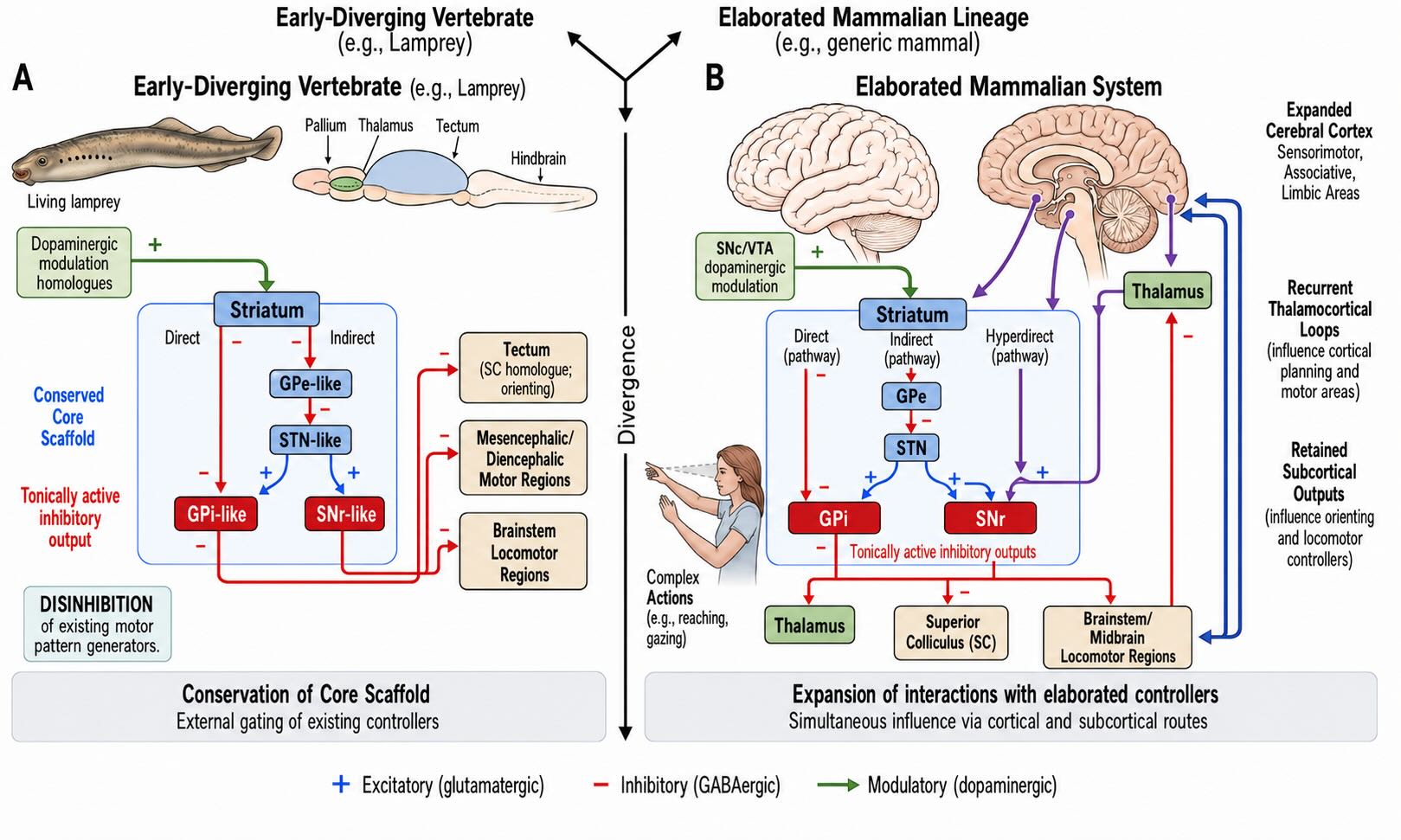
Every vertebrate faces the access problem. A swimming animal can orient toward prey or away from threat, turn left or right, accelerate or hold position. The motor patterns themselves can be generated by brainstem and spinal circuits, but they cannot all dominate the body at once. The evolutionary history of the basal ganglia is unusually informative because the recognizable core of the circuit was already present near the beginning of vertebrate history.
Lampreys are living members of an early-diverging vertebrate lineage. They are not unchanged ancestors of mammals, but their separation from the lineage leading to jawed vertebrates allows ancient features of the vertebrate nervous system to be identified. Sten Grillner and colleagues used immunohistochemistry, tract tracing, electrophysiology, and molecular markers to map the lamprey basal ganglia. They found homologues of the striatum, external and internal pallidal regions, and subthalamic nucleus, with direct and indirect routes organized according to the same principal signs found in mammals [@stephensonjones2011conservation]. Subsequent work identified a second output region homologous to the substantia nigra pars reticulata and showed that dual basal-ganglia output pathways are also ancient [@stephensonjones2012dual].
The most important physiological feature was already present. Pallidal and nigral output neurons fired tonically and released GABA onto tectal, mesencephalic, diencephalic, and brainstem targets. The basal ganglia therefore exerted an ongoing inhibitory influence over systems capable of organizing orienting, locomotion, posture, feeding, and other behavior. Activity through striatal and subthalamic routes could redistribute that influence, reducing inhibition over some targets while maintaining or increasing it over others [@stephensonjones2011conservation; @grillnerrobertson2016basal].
This organization reveals the ancestral division of labor. The basal ganglia did not need to calculate the alternating contractions that propel a lamprey through water. Brainstem and spinal networks already generated the swimming pattern. Nor did basal-ganglia output terminate only in a thalamic relay leading back to cortex, because the elaborated mammalian cortex did not yet exist. The basal ganglia acted upon the motor systems that were available. They changed which orienting and locomotor controllers could influence the body.
That is the evolutionary foundation of disinhibition. A tonically active inhibitory output can regulate access rapidly. A decrease in output releases a downstream target from part of its restraint. An increase makes that target less likely to dominate. Because the output is organized across many neurons and targets, disinhibition need not switch the whole animal from off to on. It can alter the relative influence of particular controllers, directions, effectors, or phases of an action.
Mammalian evolution expanded this architecture rather than replacing it. The pallium, and later the cerebral cortex, supplied increasingly differentiated sensory, motor, associative, and motivational input to the striatum and subthalamic nucleus. Basal-ganglia output became embedded within recurrent cortex–basal ganglia–thalamus–cortex loops. The older outputs to superior colliculus, locomotor regions, reticular formation, and other brainstem systems remained. A human basal-ganglia loop can therefore influence an action through cortical planning and motor areas, through subcortical orienting systems, or through both at once [@grillnerrobertson2016basal; @grillneretal2020motion].
The continuity matters for the argument of this unit. Evolution repeatedly added controllers above and alongside older controllers. The cerebral cortex expanded the range of possible actions and the information that could guide them. It did not remove the need to regulate access to the older motor hierarchy. The basal ganglia remained positioned between evidence about the world and body, the current state of the organism, and the systems that make behavior happen.
34.3 The anatomy of a recurrent gate
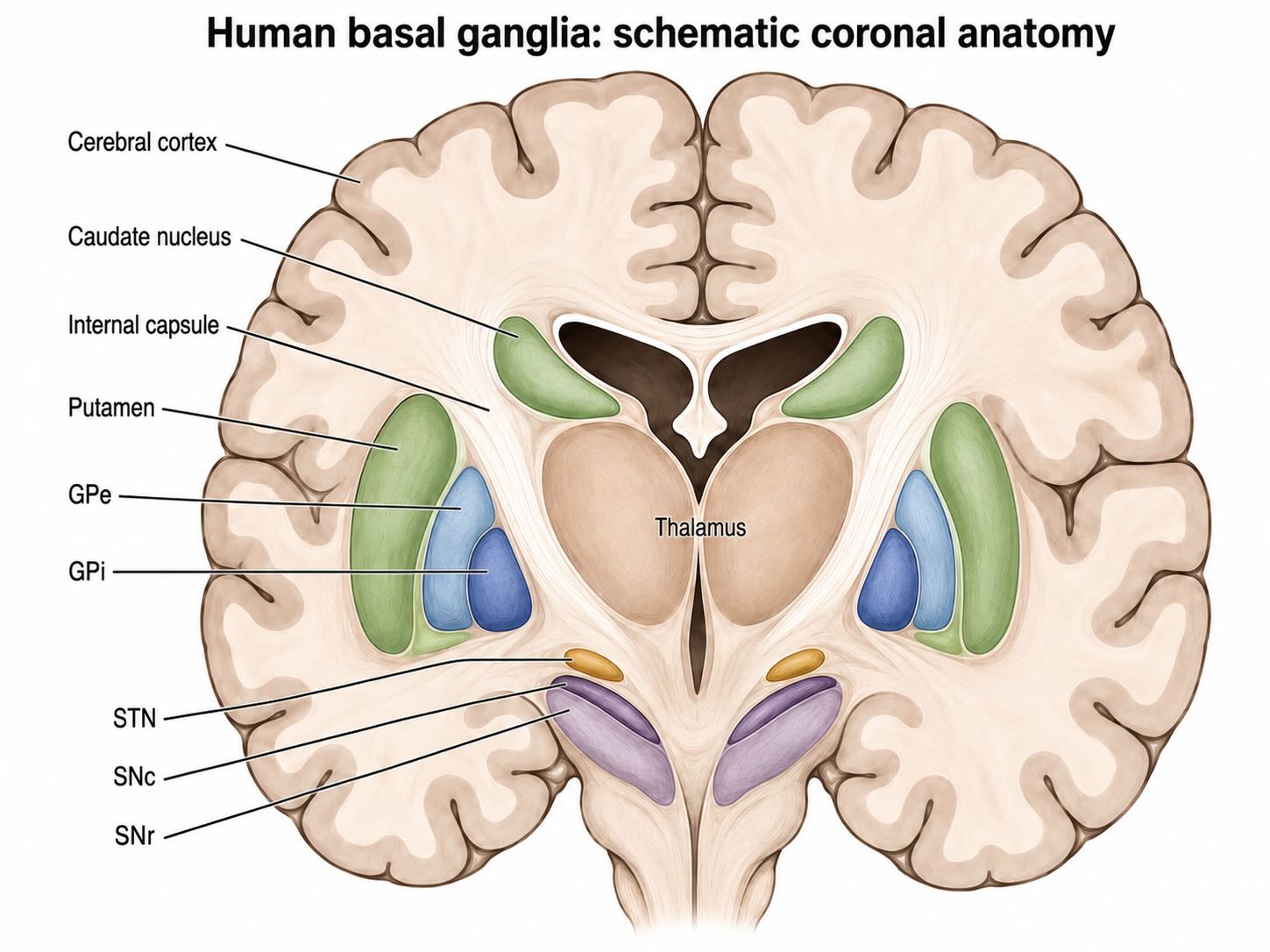
The basal ganglia are a set of interconnected nuclei rather than one compact organ. Their boundaries are anatomically distinct, but their operation depends on recurrent loops among striatum, pallidum, subthalamic nucleus, substantia nigra, thalamus, cortex, superior colliculus, and brainstem. The canonical pathways become easier to understand once the principal structures are assigned their roles.
34.3.1 The striatum receives the candidate state of action
The striatum is the largest input structure of the basal ganglia. In the dorsal striatum, the internal capsule separates the caudate nucleus from the putamen, but the two are continuous around the fiber bundles that pass between them. The ventral striatum includes the nucleus accumbens and adjoining territories. These subdivisions have genuine anatomical and functional biases, but they are not sealed compartments. Sensorimotor input is especially prominent in posterior and lateral putamen; associative input is especially prominent in anterior caudate and putamen; limbic and motivational input is especially prominent ventromedially. Between these territories lie gradients and convergence zones through which current goals, learned context, bodily state, and possible movements can interact [@alexanderetal1986parallel; @mcfarlandhaber2000convergent].
The principal output cells of the striatum are spiny projection neurons, or SPNs, traditionally called medium spiny neurons. They are GABAergic. Their axons therefore inhibit the pallidal or nigral neurons they contact. SPNs receive excitatory input from wide regions of cortex and from several thalamic nuclei. They also receive dopamine from the midbrain, local inhibition and excitation from interneurons, and collateral input from other SPNs. An SPN is not a passive relay for one cortical command. It integrates the current pattern of cortical and thalamic activity with the recent history and modulatory state of the striatal network.
Two broad SPN populations anchor the classical pathway diagram. Direct-pathway SPNs project strongly to the output nuclei and are enriched in dopamine D1 receptors. Indirect-pathway SPNs project strongly to the external globus pallidus and are enriched in dopamine D2 receptors [@gerfenetal1990d1d2]. The separation is biologically important, but the receptor and projection labels are not perfect identities. Some neurons coexpress receptors, collateral projections cross the canonical boundaries, and both populations participate during normal action. The distinction remains useful because it captures two major routes by which striatal activity changes basal-ganglia output.
34.3.2 GPi and SNr provide tonic inhibitory output
The internal segment of the globus pallidus, or GPi, and the substantia nigra pars reticulata, or SNr, are the principal output nuclei. Their neurons are GABAergic and often fire at substantial rates even in the absence of an overt movement. This tonic activity continuously inhibits downstream targets.
GPi projects prominently to motor and intralaminar regions of the thalamus. Those thalamic nuclei influence motor, premotor, supplementary motor, prefrontal, and other cortical regions. The pathway is recurrent: cortex influences basal-ganglia input, basal-ganglia output changes thalamic activity, and thalamus returns that influence to cortex.
SNr projects strongly to the superior colliculus and to several thalamic and brainstem targets. Classic work in macaques showed that pauses in SNr firing were associated with saccades and that changing GABAergic signaling in the superior colliculus could release or suppress eye movements [@hikosakawurtz1983snr; @hikosakawurtz1983colliculus]. The same general logic extends beyond eye movements. Basal-ganglia output can regulate subcortical controllers without waiting for a complete loop through cerebral cortex.
GPi and SNr are therefore commonly grouped as the output side of the circuit, but they are not interchangeable. They receive overlapping yet distinct inputs and distribute inhibition to different combinations of thalamic, collicular, and brainstem targets. The functional consequence depends on which output neurons change, which targets they contact, and when the change occurs.
34.3.3 GPe and STN form a recurrent internal network
The external segment of the globus pallidus, or GPe, occupies a central position in the indirect pathway. It was once taught as a relay inserted between striatum and subthalamic nucleus. That description misses much of its organization. GPe neurons project to STN, GPi, SNr, striatum, and other structures, while receiving input from striatum, STN, and additional sources. The nucleus is therefore a recurrent hub, not one domino in a linear chain.
At least two broad GPe populations illustrate the point. Prototypic neurons project strongly to STN and other basal-ganglia nuclei. Arkypallidal neurons project back to striatum and can suppress striatal activity. The populations differ in molecular markers, intrinsic firing, and behavioral timing [@malletetal2012dichotomous; @abdietal2015prototypic]. An introductory pathway diagram cannot display every branch, but it should not imply that GPe performs only one operation.
The subthalamic nucleus, or STN, is the major glutamatergic nucleus within the basal ganglia. Its projections excite GPi, SNr, and GPe. STN receives inhibition from GPe and excitatory input from several cortical regions. The reciprocal GPe–STN connections create a network capable of rapidly changing the timing and distribution of basal-ganglia output. The direct cortical projection to STN forms the hyperdirect pathway described below.
34.3.4 Dopamine changes excitability and learning
Dopamine reaches the dorsal striatum principally from the substantia nigra pars compacta, or SNc. It does not carry a completed instruction such as “move the right hand.” Dopamine changes the conditions under which active striatal synapses and neurons influence the circuit. Through D1- and D2-family receptors, it alters membrane excitability, transmitter release, and corticostriatal plasticity. These effects help determine which activity patterns are amplified, which are weakened, and how past outcomes change future action.
The neighboring ventral tegmental area supplies much of the dopamine reaching ventral striatum and limbic-associated forebrain. The division between SNc and VTA is useful but incomplete, just as the division between dorsal and ventral striatum is incomplete. Dopaminergic cell groups and striatal territories form overlapping gradients. This chapter concentrates on their contribution to access, initiation, and vigor. The next chapter will develop how dopamine-dependent learning changes what actions become worth selecting.
Cortical–basal-ganglia circuits are often divided into motor, oculomotor, associative, and limbic loops [@alexanderetal1986parallel]. The organization is real. Different cortical regions project preferentially to different striatal and subthalamic territories, and basal-ganglia output returns through correspondingly biased thalamic routes.
The word parallel can nevertheless suggest more separation than the anatomy supports. Cortical projections overlap. Thalamic and cortical inputs converge within portions of striatum. Striatal output influences dopaminergic territories that do not return to precisely the same starting point. GPe, STN, thalamus, and cortex contain recurrent cross-connections. These features allow information about body state, expected consequence, action context, and movement to meet without dissolving all topography.
The most useful image is therefore a set of partially segregated, interacting loops. Their biases permit selective control; their convergence permits an action to be guided by more than one kind of information.
34.4 Three routes through the human basal ganglia
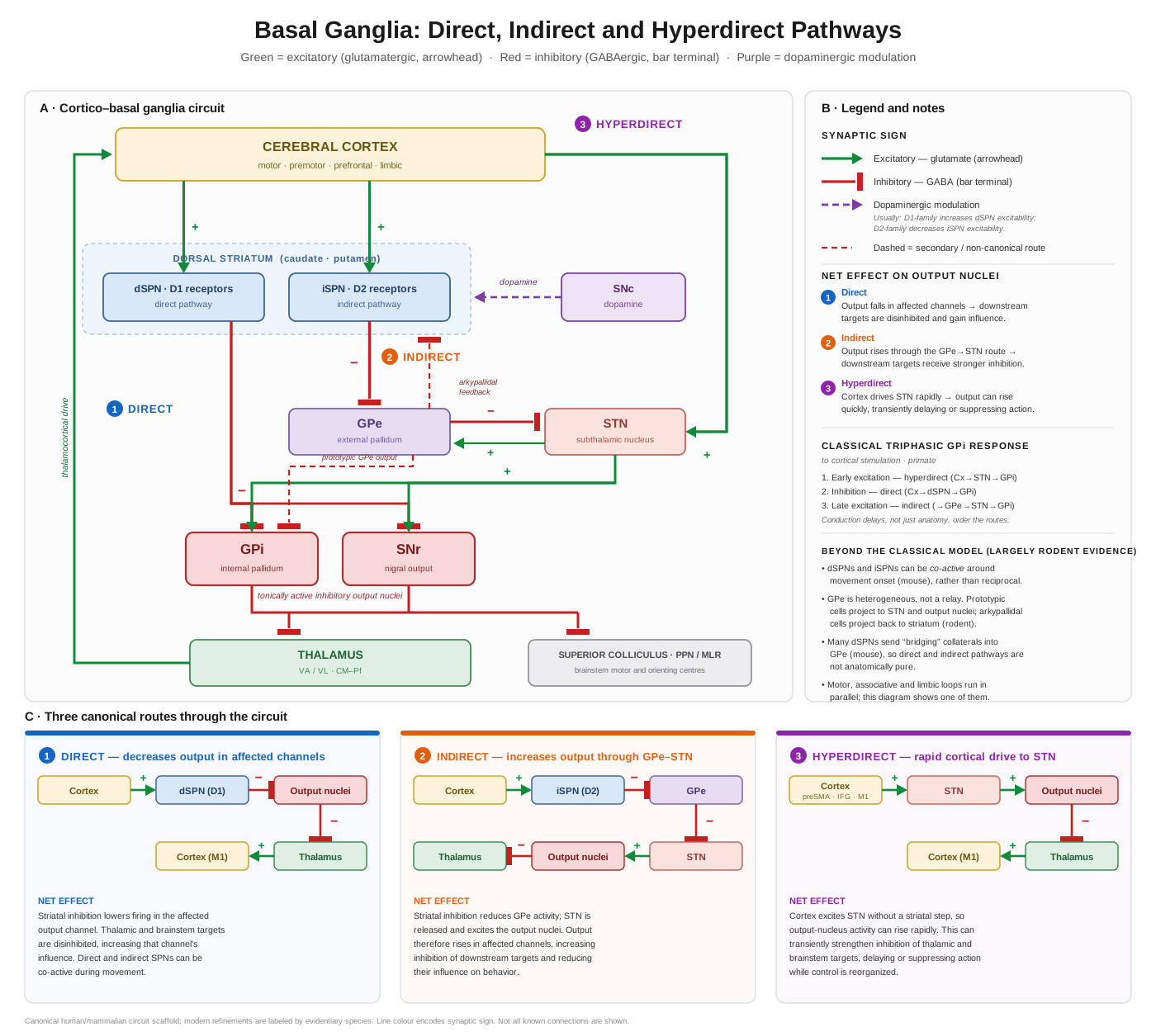
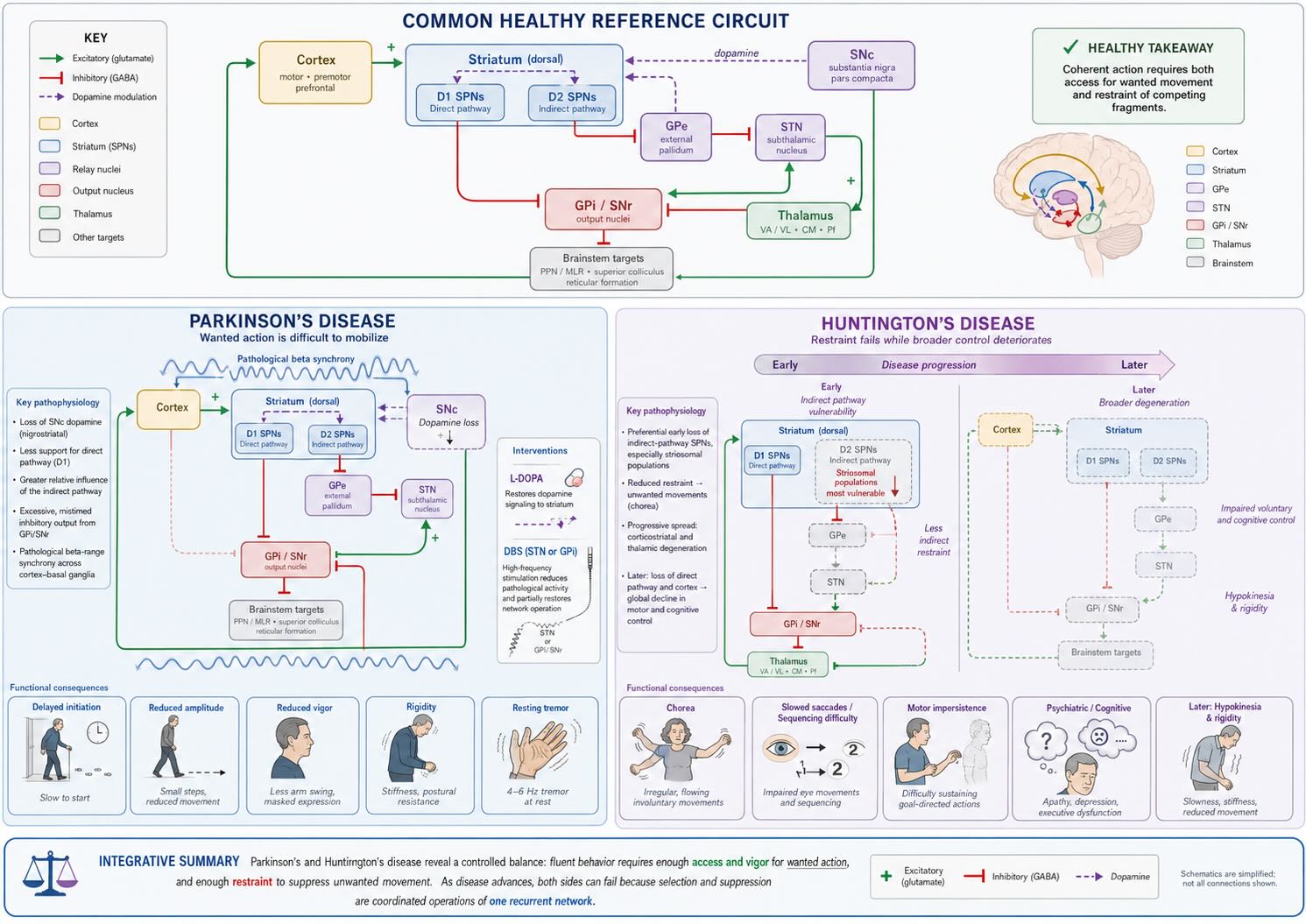
The direct, indirect, and hyperdirect pathways are the most useful entry into basal-ganglia circuitry. They identify major routes by which cortical and striatal activity changes the tonic inhibitory output of GPi and SNr. The diagram should be learned clearly before its limitations are considered.
In the pathway traces below, + marks a glutamatergic excitatory projection and − marks a GABAergic inhibitory projection. The final effect is not obtained by attaching a verbal label to one nucleus. It follows from the signs in the chain and from the fact that GPi and SNr are already active.
34.4.1 The direct pathway reduces inhibition over selected targets
The canonical direct route is:
Cortex or thalamus (+) → direct-pathway SPN (−) → GPi/SNr (−) → thalamic, collicular, or brainstem target
Cortical or thalamic input excites a population of direct-pathway SPNs. Those SPNs inhibit particular GPi or SNr neurons. Because the output neurons normally inhibit their targets, reducing their firing removes part of that inhibition. The downstream target is disinhibited and can exert greater influence on cortex or on a subcortical motor controller.
The double inhibition is the key. Direct-pathway SPNs do not excite the thalamus or superior colliculus directly. They inhibit neurons that were inhibiting those targets. The result is a relative opening of access through the affected output channel.
This route explains why the direct pathway is often called the go pathway. The name is useful only when it is kept local. Activity in a selected direct-pathway ensemble can facilitate an action or component represented by that ensemble. It does not turn on movement everywhere. Nor does direct-pathway activity necessarily determine the detailed muscle pattern. It changes the influence of the controller downstream.
34.4.2 The indirect pathway restrains actions through a recurrent route
The canonical indirect route is:
Cortex or thalamus (+) → indirect-pathway SPN (−) → GPe (−) → STN (+) → GPi/SNr (−) → target
When indirect-pathway SPNs inhibit GPe neurons, inhibition from GPe to STN can decrease. STN activity can then rise and excite GPi and SNr. Increased output-nucleus firing strengthens inhibition over downstream targets and makes the associated action less likely to gain or retain access.
That sign sequence gave the indirect pathway its traditional no-go or stop label. Again, the label should be applied to a channel and time, not to the animal as a whole. An indirect-pathway ensemble can restrain an alternative direction, an inappropriate response, a component that should not yet occur, or an action that has ceased to be useful.
The complete indirect network is richer than the five-link chain. GPe projects directly to GPi and SNr as well as to STN. STN excites GPe. Some GPe neurons project back to striatum. The effect of indirect-pathway activity therefore depends on which GPe population is recruited and on the current state of the GPe–STN–output network. The canonical chain captures an important net route toward increased inhibitory output; it does not reduce GPe and STN to passive relays.
34.4.3 The hyperdirect pathway can rapidly raise the conditions for access
The hyperdirect route bypasses striatum:
Cortex (+) → STN (+) → GPi/SNr (−) → target
Frontal and motor cortical regions project directly to STN. Because both links before the output nuclei are excitatory, cortical activity can rapidly increase GPi/SNr firing and strengthen inhibition of downstream targets. The route is called hyperdirect because it reaches the output side of the basal ganglia with fewer intervening synapses than the direct or indirect pathways [@nambuetal2002hyperdirect].
The hyperdirect pathway is well suited to altering the threshold for action when conflict or surprise demands more evidence. It is also recruited during rapid stopping. In people undergoing deep-brain stimulation surgery, stimulation of STN evoked very short-latency potentials in inferior frontal cortex, supporting a direct anatomical connection. During a stop-signal task, stopping-related cortical activity preceded STN activity, and stronger prefrontal–subthalamic coupling predicted faster stopping [@chenetal2020hyperdirect].
Rapid does not mean isolated. The hyperdirect route can produce an early increase in inhibitory output while slower striatal routes determine which action remains suppressed and which can resume. A stop can also be selective: the nervous system may cancel one prepared response while preserving posture, gaze, speech, or another action. The hyperdirect pathway contributes to that reorganization; it is not a single panic button that turns off the motor system.
34.4.4 Dopamine biases an active circuit
The classical model adds dopamine by contrasting D1-enriched direct-pathway SPNs with D2-enriched indirect-pathway SPNs. Dopamine acting at D1 receptors generally increases the responsiveness of active direct-pathway neurons and promotes forms of corticostriatal plasticity that strengthen their influence. Dopamine acting at D2 receptors generally reduces the responsiveness of active indirect-pathway neurons and supports a different pattern of plasticity [@gerfenetal1990d1d2]. In that limited sense, dopamine can bias the circuit toward access and expression.
The phrase dopamine promotes movement is too crude. Dopamine is not a continuously rising accelerator signal. Its effects depend on receptor, cell state, timing, synaptic history, and striatal territory. Dopamine also changes how forcefully or rapidly an action is expressed and how outcomes modify the probability of future actions. The severe loss of nigrostriatal dopamine in Parkinson’s disease exposes these functions because the system becomes poor at initiating and invigorating action even though the body retains much of the machinery needed to execute it.
The pathway model can now be summarized without turning it into a set of pedals. Direct-pathway activity can reduce inhibitory output over selected targets. Indirect-pathway activity can strengthen or redirect restraint. Hyperdirect activity can rapidly raise the conditions for access. Dopamine alters the gain and plasticity of the striatal populations participating in those processes. The useful unit is not one pathway in isolation, but the changing pattern produced by all three routes across the output nuclei.
34.5 The diagram is a scaffold, not the moving circuit
The direct–indirect model earned its place in textbooks because it organizes the signs of the principal connections and predicts important effects of dopamine loss and pathway perturbation [@albinyoungpenney1989; @delong1990primate]. Its most literal version, however, pictured two populations waiting on opposite sides of a decision: direct-pathway neurons active for the chosen movement, indirect-pathway neurons active to prevent movement. Recordings from identified cells show a more dynamic arrangement.
In mice initiating learned actions, both direct- and indirect-pathway SPNs increased activity. The activity in each population carried information about the movement that was about to occur [@cuietal2013concurrent]. Pathway-specific interventions likewise show complementary contributions during action initiation and execution rather than one population issuing go while the other remains silent [@tecuapetlaetal2016complementary]. Both routes are engaged because producing one coherent action requires more than releasing a winner. The system must shape its onset, prevent incompatible components, regulate transitions, and preserve the posture and other actions that should continue.
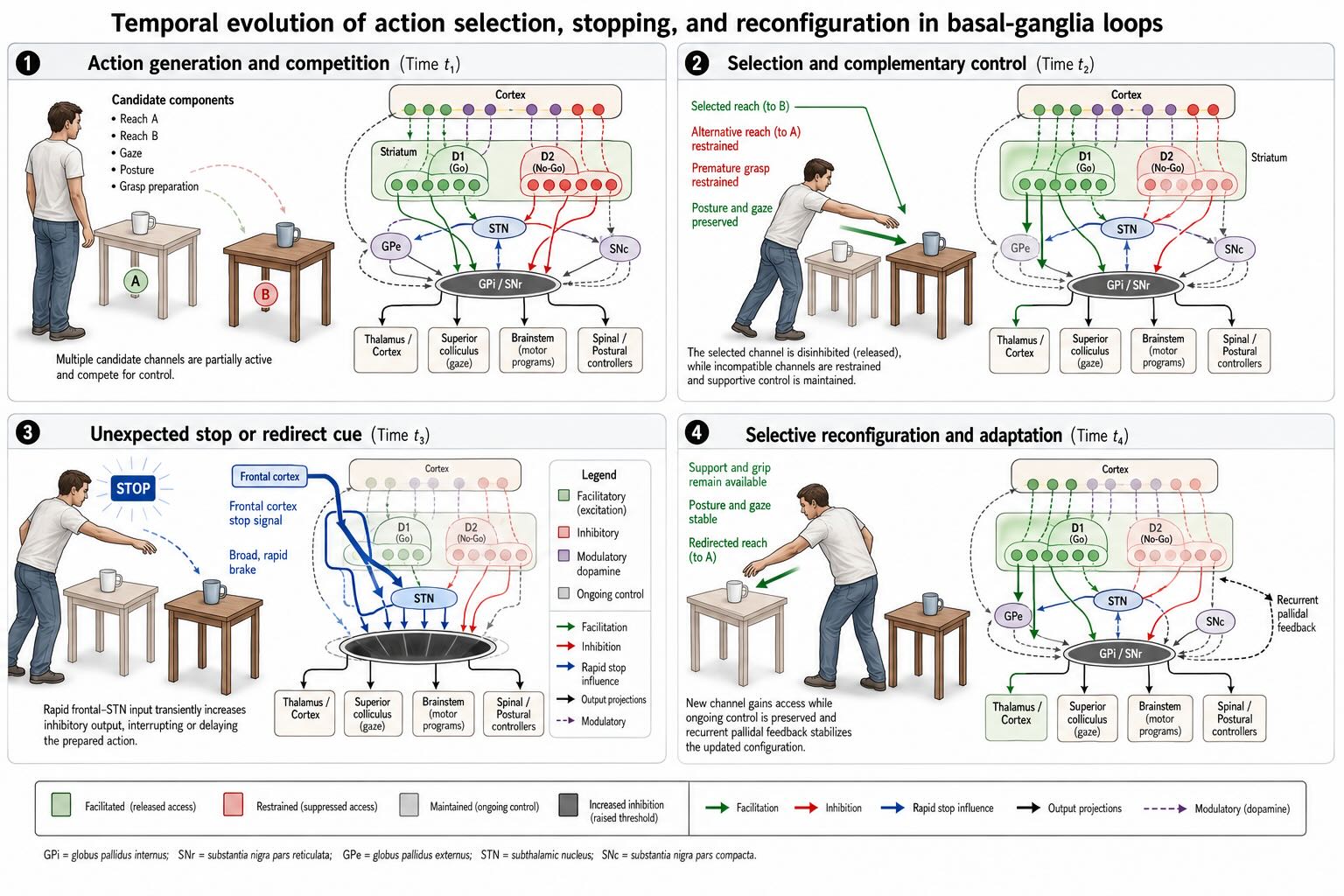
Consider reaching for a cup while standing. Parietal and premotor networks specify the target and possible grasps. Motor and brainstem systems prepare the arm and stabilize the body. The eyes may remain on the cup or briefly orient elsewhere. Within the basal ganglia, activity related to the selected reach can reduce inhibition over relevant thalamocortical and brainstem targets. At the same time, other striatal and subthalamic populations can restrain a reach in the wrong direction, premature finger closure, a competing hand action, or a turn of the body that would destabilize the movement. Direct and indirect activity can therefore rise together while exerting different effects across channels and phases.
The word channel is useful if it is not mistaken for a labeled cable carrying one complete behavior. Striatal neurons are organized topographically, and related cortical inputs converge within biased territories. Yet a natural action is distributed across many populations. Reaching involves target selection, eye–hand coordination, postural preparation, arm transport, hand shaping, contact, and force control. Different combinations of those components can be facilitated or restrained at different times. A basal-ganglia channel is therefore better understood as a temporarily coordinated population influencing part of a control problem.
34.5.1 Selection is a pattern across output nuclei
Tonic inhibition makes the pattern of pauses and increases in GPi/SNr activity consequential. A pause can release one downstream population from restraint. An increase can reduce the influence of another. Changes in synchrony and timing can alter when thalamic or brainstem neurons respond even when average firing rate changes little. What matters is the spatiotemporal distribution of output, not a single number describing how inhibited the motor system is.
This is why a simple center–surround metaphor is sometimes helpful but insufficient. Focused disinhibition of a selected action accompanied by broader suppression of alternatives captures a real computational requirement. The anatomical network is not arranged as one neat center surrounded by one uniform ring. Cortical, striatal, pallidal, subthalamic, nigral, and thalamic populations overlap and recur. The surround can be selective, changing with the task, and the selected action itself can be a coordinated collection of channels rather than one point.
The recurrent architecture removes the need for an additional chooser. No neuron reads all candidate actions, declares a winner, and sends the decision to the basal ganglia. Cortical and thalamic inputs reflect sensory evidence, goals, rules, expected consequences, current state, and actions already underway. Those inputs recruit striatal, pallidal, and subthalamic populations with different learned weights. The resulting output changes which controllers influence the body. Their sensory consequences return as new evidence, and the competition changes again.
The network does not represent a decision after it has been made elsewhere. Its evolving dynamics are part of making the action effective.
34.5.2 Stopping is a race and a reconfiguration
Stopping illustrates the advantage of several routes operating at different speeds. An unexpected stop signal can recruit frontal cortex and STN quickly, increasing inhibitory output before the prepared response crosses the point at which it becomes difficult to cancel. Striatal routes continue to evolve and can help suppress the particular action while allowing an alternative or a corrected action to emerge. Experiments in rodents support a race between rapid subthalamic and slower striatal influences on basal-ganglia output [@schmidtetal2013canceling]. Human recordings show a temporal cascade from frontal stopping-related activity through motor cortex to muscle [@janaetal2020stopping].
An action that is already underway cannot always be erased. The controller may instead shorten it, reduce its force, prevent its next component, or launch a compensating movement. A person carrying a full cup who hears “stop” must preserve grip and posture while halting forward progress. Effective stopping is therefore not the absence of all motor output. It is a rapid reallocation of access within a body that must remain controlled.
The same principle applies to switching. When circumstances change, the formerly selected action must lose influence while another gains it. Hyperdirect, indirect, and direct routes can contribute in sequence and in parallel. The basal ganglia regulate the transition; the detailed replacement action is still implemented by the cortical, collicular, brainstem, cerebellar, spinal, and muscular systems with which the loops interact.
34.6 Selection includes vigor, commitment, and switching
Action selection is sometimes described as though the nervous system chooses a noun: reach, walk, speak. Natural behavior requires additional decisions that cannot be separated cleanly from the action itself. When should the reach begin? How quickly should the hand move? How much force should be prepared? How long should the action continue before another takes its place? A weak and delayed reach may fail even if the correct target was selected.
34.6.1 Access is graded
Disinhibition is often drawn as an open or closed gate. The underlying physiology is graded. A partial reduction in GPi or SNr output can increase the probability, speed, or gain with which a downstream controller responds. A stronger or more coordinated change can allow the action to dominate. Competing populations can approach access without crossing the same threshold. The selected action can also remain provisional until evidence and expected benefit justify commitment.
This graded control is valuable in an uncertain world. A foraging animal can prepare an orienting movement toward a faint sound without immediately abandoning its current behavior. A person can begin to shape the hand for a likely grasp while visual evidence about the object continues to accumulate. Basal-ganglia loops help determine when preparation becomes commitment, but the commitment is expressed through the motor systems already preparing the action.
Conflict can raise the effective threshold. When two responses are strongly activated, cortical input to STN and activity through indirect routes can delay access while additional evidence arrives. When one action becomes clearly favored, direct-pathway influence over the relevant output populations can increase. The result is not necessarily a conscious choice. The same architecture can regulate a saccade, a postural correction, a learned sequence, or a decision made under an explicit rule.
34.6.2 Vigor is part of the choice
An animal should not expend the same energy on every action. A distant reward may justify a rapid run when it is valuable and scarce, but not when the animal is exhausted or the expected benefit is small. Movement vigor therefore links motor control to motivation and energetic state.
Nigrostriatal dopamine is strongly implicated in that link. In dopamine-depleted mice, movements became less frequent, slower, and smaller, while restoring dopamine recovered both movement and striatal representations of vigor [@panigrahietal2015vigor]. Brief activity in substantia nigra dopamine neurons before self-initiated movement can change the probability and vigor of future movements without specifying their detailed direction [@dasilvaetal2018dopamine]. These findings place dopamine between a simple reward signal and a simple motor trigger. It changes how strongly the organism commits resources to an action.
Parkinson’s disease makes the distinction visible. People with Parkinson’s disease can often move faster when explicitly instructed, yet their self-selected movements remain unusually slow and small. In one influential experiment, patients increased speed when task demands required it, showing that the machinery for faster movement remained available. They did not spontaneously choose the higher vigor that healthy participants used under the same conditions [@mazzonietal2007vigor]. Dopamine loss therefore changes the implicit cost–benefit setting of action as well as the mechanics of execution.
Vigor does not belong to dopamine alone. Motor cortex, cerebellum, brainstem, spinal circuits, muscle state, and sensory feedback all determine the realized speed and force. Basal-ganglia loops contribute by altering the gain and commitment with which those systems are recruited. A selected action is not merely admitted through a gate; it is assigned a level of pursuit.
34.6.3 Current need changes the competition
The opportunities described in Chapter 32 do not have fixed significance. A cup affords grasping, drinking, moving, or ignoring. Which relation matters depends on the state of the organism and the task already underway. Thirst changes the expected benefit of drinking. Fatigue changes the cost of standing or climbing. Threat changes the priority of orienting and escape. Social context changes whether an offered hand should be grasped.
These variables influence basal-ganglia loops through distributed routes. Prefrontal, orbitofrontal, cingulate, insular, motor, and parietal cortices project to biased striatal and subthalamic territories. Thalamic inputs report context, salience, and ongoing state. Hypothalamic and brainstem systems alter arousal, autonomic support, and dopaminergic activity. The striatum therefore receives a changing population pattern rather than a single scalar command labeled hunger or value.
The basal ganglia help convert that pattern into differential access. In a thirsty person, visual and contextual evidence related to the cup recruits networks whose learned weights favor approach, grasp, and drinking. In a laboratory instruction to leave the cup untouched, rule-related input favors restraint despite the same visual affordance. Selection is in the service of need, but no separate structure first computes the organism’s true need and then hands the answer to a motor selector. Need, context, and possible action meet within recurrent loops.
34.6.4 Sequences require release and restraint at their boundaries
Many actions unfold as sequences. Reaching must give way to grasping; grasping to lifting; lifting to transport. Speech requires one articulatory pattern to yield to the next. Locomotion requires alternation among phases while the overall behavior continues. Basal-ganglia activity often changes near the beginning and end of learned sequences, where access must be opened, sustained, or transferred.
This does not make the basal ganglia a storage site for complete motor programs. Cortical, brainstem, spinal, and cerebellar circuits organize the detailed sequence and its timing. Basal-ganglia loops regulate when a sequence gains control, how vigorously it proceeds, and when its components or the sequence as a whole should terminate. With practice, those relations can become faster and more automatic. The learning processes that change them, and the transition from outcome-sensitive action to habit, belong to the next chapter.
The concept of selection can now be stated more precisely. It includes the identity of an action, but it also includes access, commitment, vigor, maintenance, termination, and switching. These functions are different views of one control problem: how a limited body is allocated among possible and ongoing actions.
34.7 Two diseases, two lessons—not mirror images
Parkinson’s disease and Huntington’s disease are often placed on opposite sides of the direct–indirect pathway diagram. The comparison is useful because one disorder prominently impairs the initiation and scaling of wanted action while the other can release unwanted movement. It becomes misleading when the diseases are treated as selective experimental lesions that move one shared brake in opposite directions. Each is a progressive disorder affecting several cell types, loops, and timescales.
34.7.1 Parkinson’s disease: action is available but difficult to mobilize
The defining pathology of Parkinson’s disease includes degeneration of dopamine neurons in the substantia nigra pars compacta and severe loss of dopamine in dorsal striatum. The cardinal motor sign is bradykinesia: movements are slow to begin, slow in execution, or reduced in amplitude. Repeated movements may become progressively smaller. Facial expression, arm swing, handwriting, speech amplitude, and automatic adjustments can all be diminished. Rigidity and resting tremor are common, and postural instability becomes prominent in many patients.
The classical pathway model gives a useful first account. Dopamine loss reduces support for direct-pathway activity and removes D2-mediated modulation from indirect-pathway SPNs. The resulting circuit tends to increase inhibitory GPi/SNr influence over thalamic and brainstem targets. Controllers that can still generate movement have greater difficulty gaining sufficient access. Optogenetic manipulation of pathway-defined striatal populations in dopamine-depleted mice provided causal support for this architecture: increasing direct-pathway activity or decreasing indirect-pathway influence could improve parkinsonian movement [@kravitzetal2010parkinsonian].
That account explains why dopamine replacement can release movement, but it does not explain the complete syndrome. Parkinsonian basal ganglia show abnormal timing, synchrony, and oscillation as well as changes in average firing. In particular, activity in the beta range can occur in prolonged bursts across cortex and basal ganglia. Longer beta bursts are associated with greater motor impairment, and dopaminergic medication or effective deep-brain stimulation reduces their prevalence [@tinkhauseretal2017bursts; @tinkhauseretal2017adaptive]. The disease therefore alters the coordination of a recurrent network, not merely the height of one tonic brake.
Deep-brain stimulation, or DBS, makes the same point. High-frequency stimulation of STN or GPi can improve bradykinesia, rigidity, and tremor even though stimulation does not simply silence every neuron near the electrode. It changes local firing, axonal transmission, network synchrony, and the temporal pattern reaching connected structures. Modern adaptive systems can deliver stimulation in relation to pathological activity rather than continuously, using circuit dynamics as part of the treatment target.
Parkinsonian bradykinesia also exposes the relation between selection and vigor. The intended action may be known, and the relevant muscles may be strong enough, yet the spontaneous movement is delayed or underscaled. External cues can sometimes improve gait or movement amplitude by recruiting alternative sensory and cortical routes. The phenomenon does not mean that cortex bypasses a completely broken selector. It shows that access is influenced by the pattern and context in which an action is prepared.
Resting tremor is the feature least well explained by a simple increase in basal-ganglia output. Tremor involves interactions among basal ganglia, thalamus, cerebellum, cortex, and peripheral feedback. Its presence is a useful reminder that a disease can reveal a circuit’s function without every symptom following from one pathway sign.
The central lesson of Parkinson’s disease is nevertheless clear. Dopamine-depleted basal-ganglia networks make wanted actions difficult to mobilize and insufficiently vigorous. The failure is not paralysis. It is a failure to give available controllers the access, gain, and temporal coordination required for fluent action.
34.7.2 Huntington’s disease: unwanted movement escapes while voluntary control deteriorates
Huntington’s disease is caused by an expanded CAG repeat in the HTT gene and is inherited in an autosomal dominant pattern [@hdcollaborative1993gene]. The mutation produces a progressive disorder of striatum, cortex, and other systems. Motor, cognitive, and psychiatric changes can all be prominent.
Early neuropathology often affects striatal projection neurons of the indirect pathway more severely than direct-pathway neurons. Classic postmortem studies showed disproportionate loss of striatal neurons projecting to GPe and relative preservation of some neurons projecting to GPi and SNr during early stages [@reineretal1988differential; @dengetal2004differential]. Modern single-nucleus analyses refine that result: vulnerability depends not only on direct versus indirect identity but also on striosome–matrix organization and transcriptional state. Indirect-pathway SPNs in striosomal compartments appear especially vulnerable early in human disease [@matsushimaetal2023vulnerabilities].
Loss of indirect-pathway influence can reduce restraint over downstream targets and contribute to chorea, the irregular, flowing intrusion of involuntary movement. Chorea demonstrates why suppression is an active achievement. A healthy nervous system does not merely generate the intended action. It continually prevents fragments, postures, and transitions that would interfere with it.
The person with Huntington’s disease is not simply moving too much. Chorea can coexist with impaired voluntary control, slowed saccades, poor sequencing, motor impersistence, and difficulty using sensory information to guide action. Cognitive and psychiatric changes may precede or accompany the obvious motor syndrome because associative and limbic corticostriatal loops are also affected. As degeneration spreads, later disease can become hypokinetic and rigid. The early release of unwanted movement therefore gives way to a broader failure of the recurrent system.
Huntington’s disease also extends beyond striatal cell death. Corticostriatal communication, interneurons, dopamine signaling, and cortical populations change over the course of the illness. The mutation is present throughout the nervous system, and the decades-long disease process alters development, compensation, and network function. An early bias toward indirect-pathway vulnerability remains mechanistically informative, but Huntington’s disease is not equivalent to deleting one arrow from the pathway diagram.
34.7.3 The comparison reveals a controlled balance
Parkinson’s and Huntington’s diseases are not mirror pathologies. Their causes differ, their vulnerable populations differ, and their progression recruits different combinations of circuits. Parkinson’s disease begins with a major dopaminergic disturbance that changes the activity and plasticity of both principal striatal pathways. Huntington’s disease begins from a mutant protein expressed widely and often produces an early asymmetry in striatal vulnerability before broader degeneration.
Together, however, the disorders reveal two requirements of coherent action. Wanted actions must gain enough access and vigor to control the body. Unwanted actions and components must remain restrained. Too little effective access produces poverty and underscaling of action. Too little restraint allows involuntary movement to intrude. As either disease advances, both sides of the problem can fail because selection and suppression are not independent modules. They are coordinated operations of one recurrent network.
34.8 How basal-ganglia function is studied
The basal ganglia are deep, recurrent, and distributed. No single method shows the entire operation. Their role in action has emerged from convergence among evolutionary anatomy, pathway-specific experiments, recordings during behavior, human neurosurgery, disease, and formal models.
Comparative anatomy and physiology reveal which features preceded the mammalian cortex. In lamprey, tract tracing identifies the nuclei connected by direct and indirect routes, molecular markers distinguish cell classes, and whole-cell recordings establish whether the projections are excitatory or inhibitory. The firing of output neurons can be recorded while their projections to tectal and brainstem motor regions are mapped [@stephensonjones2011conservation; @stephensonjones2012dual]. These experiments make the evolutionary claim unusually concrete: conservation concerns connections, transmitters, receptor expression, and physiological operation, not resemblance in gross shape alone.
Comparative work also sets a boundary. A lamprey preparation can show that an ancestral basal-ganglia architecture regulated access to subcortical motor systems. It cannot establish that every human cognitive or motor function uses the circuit in the same way. The argument moves from conserved anatomy to conserved control problem, then asks how later pallial and cortical systems entered the loops.
Anatomical tracing maps the partially segregated and convergent organization of mammalian circuits. Injecting tracers into cortical, striatal, pallidal, nigral, subthalamic, or thalamic territories reveals where axons originate and terminate. Multiple injections show that sensorimotor, associative, and limbic loops have biased territories while still overlapping [@mcfarlandhaber2000convergent]. Tracing establishes possible routes of influence. It does not, by itself, show which route is active during a particular behavior or whether a synapse facilitates or restrains an action at that moment.
Cell-type-specific recording and perturbation transformed the direct–indirect model. Genetically targeted indicators can measure activity in D1- or D2-enriched SPNs while an animal moves. Optogenetic or chemogenetic tools can excite or inhibit one population and test the resulting behavior. These methods revealed concurrent activity in both pathways and demonstrated that manipulating either route changes initiation, execution, and movement vigor [@cuietal2013concurrent; @tecuapetlaetal2016complementary; @yttridudman2016velocity].
The causal power of these tools requires careful interpretation. Synchronously driving a large genetically defined population is not the same event as the sparse, timed ensemble activity produced during natural behavior. A population can be sufficient to change movement without normally acting alone. The strongest inference comes when natural recording and selective perturbation point toward the same operation.
Multi-site electrophysiology follows activity across cortex, striatum, GPe, STN, GPi or SNr, thalamus, and muscle. Simultaneous recording can reveal whether changes precede movement, follow it, or predict a stop. It can test whether neurons carry information about direction, vigor, sequence boundary, conflict, or outcome. Because the circuit is recurrent, timing is crucial: an activity change correlated with movement may be a cause, a consequence, a prediction, or feedback about an action already underway.
Primate experiments provide access to the oculomotor and skeletomotor systems most comparable to humans. Single-unit recording established tonic SNr and pallidal output, movement-related pauses and increases, and the relation between nigral output and superior-collicular control of saccades [@hikosakawurtz1983snr]. Reversible inactivation, pharmacological injection, and focal stimulation can then test whether changing a nucleus releases, delays, or redirects behavior. Primate tracing also reveals the large-scale cortical and dopaminergic gradients that cannot be inferred safely from the smaller rodent brain.
Human neurosurgery provides rare direct recordings from deep nuclei. During implantation of DBS electrodes, investigators can record single neurons and local field potentials from STN or GPi. Temporary cortical electrodes can be combined with subthalamic recording and stimulation, revealing the timing and connectivity of the hyperdirect pathway [@chenetal2020hyperdirect]. Chronic sensing electrodes now permit activity to be followed during everyday movement and adaptive stimulation. These participants have neurological disease, so their recordings cannot simply be treated as a normal control group. They are nevertheless indispensable when interpreted alongside animal and noninvasive evidence.
Lesion, medication, and stimulation studies show what happens when the network is perturbed over longer timescales. Parkinson’s disease reveals the consequences of dopamine loss; L-DOPA tests which functions can be restored by dopamine replacement; DBS tests the causal importance of STN, GPi, and their connected networks. Huntington’s disease combines genetics, longitudinal behavior, imaging, and postmortem cell-type analysis. These diseases are not clean lesions, but their complexity is informative. They reveal how a recurrent network adapts, becomes pathological, and eventually fails.
Computational models force verbal claims to specify signs, delays, firing patterns, and decision rules. The classical rate model asked how dopamine loss should change mean activity through direct and indirect routes [@albinyoungpenney1989; @delong1990primate]. Race models ask whether a rapid hyperdirect signal can reach the output nuclei before a prepared action escapes [@schmidtetal2013canceling]. Dynamical models ask how recurrent populations settle into, sustain, or leave an action state. A model is most useful when it predicts a measurable pattern that distinguishes it from alternatives.
The cumulative case is therefore stronger than the pathway diagram alone. Comparative work identifies the ancient architecture. Anatomy maps its channels and convergence. Cell-type recording shows coactive populations. Perturbation establishes causal influence. Human recording exposes the hyperdirect route and pathological rhythms. Disease demonstrates failures of access, vigor, and restraint. Models explain how those observations can arise from a recurrent inhibitory gate.
34.9 From selection to learning what is worth selecting
The weights entering an action competition are not fixed. A movement that succeeds becomes easier to recruit in the same context. A movement followed by pain becomes less likely. Practice changes the boundaries and vigor of a sequence. Bodily state changes what outcome is worth the effort. The basal ganglia therefore sit at the junction of action selection and action learning.
Dopamine is central to that junction. The same nigrostriatal signal that changes the excitability and vigor of the current circuit also changes corticostriatal synapses according to what happened. Dopamine neurons can respond when an outcome is better or worse than expected, allowing recent action and context to be assigned credit. Direct- and indirect-pathway synapses do not learn identical lessons, and the consequences differ across sensorimotor, associative, and limbic territories.
The anatomical divisions introduced in this chapter are therefore temporary emphases, not isolated machines. Ventral striatal territories receive especially strong information about motivational and affective significance. Associative territories integrate rules, context, and action–outcome relations. Sensorimotor territories become increasingly influential as practiced actions are triggered rapidly by familiar situations. Connections through midbrain dopamine systems form an ascending striato–nigro–striatal spiral from ventromedial toward progressively more dorsal and lateral territories [@haberetal2000spiral]. That spiral is one route through which motivational and learned information can influence action; it is not a conveyor belt that inevitably turns every valued action into a habit.
The next chapter develops this learning problem. It will ask how outcomes acquire value, how prediction errors revise action weights, why behavior can shift from outcome-sensitive control toward habit, and how the same learning machinery becomes vulnerable in addiction. The present chapter supplies the circuit consequence of that learning: changing synaptic weights changes which controllers gain access, how strongly they act, and what remains restrained.
34.10 Coda: controlling access to control
The motor system assembled across this unit is not a chain ending in one command center. Lower motor neurons provide the final route to muscle. Spinal circuits organize reflexes, synergies, and rhythmic patterns. Brainstem systems regulate posture, orienting, locomotion, gaze, and whole-body state. Cortical networks specify flexible actions in relation to objects, goals, and learned rules. Cerebellar loops predict how those actions will change the body and sensory world.
Each level makes several actions possible. The basal ganglia help determine which of those possibilities become effective.
Their ancient architecture is suited to the task. Striatal and subthalamic input converge on pallidal and nigral output neurons that inhibit thalamic, collicular, and brainstem targets. Direct, indirect, and hyperdirect routes redistribute that inhibition at different speeds. Dopamine changes the gain and plasticity of the striatal populations participating in the contest. The result is not one switch for movement. It is a changing pattern of access across the hierarchy of controllers.
That pattern can release an orienting movement from nigral restraint, increase the influence of a cortical reach through thalamus, prevent a competing response, or interrupt a prepared action when evidence changes. It can regulate whether a movement is tentative or committed, weak or vigorous, sustained or terminated. Because the output reaches both cortex and older subcortical motor systems, the same architecture can control actions that depend heavily on learned cortical rules and actions organized largely below cortex.
The comparison with the cerebellum is especially useful. Basal-ganglia loops and cerebellar loops both receive broad information about action and return influence to cerebral and brainstem controllers. Their principal contributions differ. Cerebellar circuits predict consequences, estimate evolving state, and recalibrate control from error. Basal-ganglia circuits regulate which controllers gain influence, how strongly they are recruited, and when their claim on the body should end. A selected action still requires prediction; an accurate prediction still requires an action to have been selected.
Parkinson’s and Huntington’s diseases expose the balance from different directions. In Parkinson’s disease, available actions become difficult to initiate and underscaled because dopamine loss disrupts the gain, plasticity, and timing of the network. In Huntington’s disease, early loss of particular striatal populations weakens restraint and permits involuntary movement to intrude, even as voluntary and cognitive control deteriorate. The disorders are not mirror images, but both show that coherent action requires access and suppression to be coordinated.
The basal ganglia therefore should not be defined as a movement center, a brake, or an abstract chooser. Each metaphor captures one feature and misses the recurrent system. The positive account is more useful:
Basal-ganglia loops control access to control. They bias which embodied controllers influence the body, set the vigor and commitment of the selected action, restrain interference, and reorganize access when the world or the organism changes.
That operation is ancient because the problem is ancient. Every vertebrate must turn many possible actions into one coherent course of behavior. Human cortex expanded the evidence, goals, and rules that can enter the competition. It did not eliminate the circuit that makes one possibility consequential.
The next chapter asks how experience changes the competition. Selection solves what the organism will do now. Reinforcement learning changes what it will be prepared to do next time.
We are confident that:
- A recognizable basal-ganglia core containing striatum, pallidal output, GPe-like and STN components, dopaminergic modulation, and direct- and indirect-like routes was present early in vertebrate evolution.
- GPi and SNr provide tonic GABAergic output to thalamic, superior-collicular, and brainstem targets.
- The direct, indirect, and hyperdirect pathways are major anatomical routes through the human basal ganglia.
- Direct-pathway activity can reduce inhibitory output over selected downstream targets, while indirect and hyperdirect activity can increase or redistribute restraint.
- Direct- and indirect-pathway SPNs are both active during normal action initiation; the pathways are not mutually exclusive go and stop switches.
- GPe is a heterogeneous recurrent hub with important projections to STN, striatum, and basal-ganglia output nuclei.
- Nigrostriatal dopamine alters SPN excitability and corticostriatal plasticity and is required for normal initiation and vigor of movement.
- Parkinson’s disease involves severe nigrostriatal dopamine loss and disrupts the rate, timing, synchrony, and gain of basal-ganglia circuits.
- Huntington’s disease is a progressive genetic disorder with early vulnerability of particular striatal projection-neuron populations, followed by broader corticostriatal degeneration.
- Effective action requires both sufficient access for wanted actions and active restraint of unwanted actions.
We have good reason to think that:
- Basal-ganglia loops regulate a family of related variables that includes action access, commitment, vigor, maintenance, stopping, and switching.
- Selection is implemented by changing patterns across populations and output targets rather than by one nucleus or one scalar brake signal.
- Hyperdirect cortical input to STN contributes to rapid stopping and to raising the conditions for action when conflict is high.
- Sensorimotor, associative, and limbic loops are partially segregated but interact through convergence and recurrent connections.
- Dopamine helps couple expected benefit and energetic cost to the vigor with which an action is pursued.
- The ancient basal-ganglia operation was repeatedly recruited into expanded cortical loops without losing its older control over collicular and brainstem systems.
We remain genuinely unsure about:
- The exact population code by which natural actions and their components are represented across striatum, pallidum, STN, and output nuclei.
- How broadly or selectively the hyperdirect pathway suppresses action under different behavioral demands.
- How labor is divided among basal-ganglia contributions to selection, vigor, timing, reinforcement, and credit assignment.
- How changing firing rate, burst structure, oscillatory synchrony, and phase relationships each contribute to normal movement and to Parkinsonian symptoms.
- How human sensorimotor, associative, and limbic loops exchange information during complex decisions without losing useful topography.
- Which circuit changes drive the transition from flexible action to habit, and when that transition becomes resistant to current outcomes.
The remaining questions concern the detailed population dynamics and learning rules. They do not weaken the central conclusion that basal-ganglia loops regulate access to action within the vertebrate hierarchy of embodied controllers.